By Kelsey Barnett-Fischels, Communications Director
Bill Finch, founding director of Paint Rock Research Center, was itching to light a fire. Early summer rains and high humidity had held us up for weeks already. Finch tossed a tuft of grass on the dirt fire break, holding lighter to blades, and watched the flames erupt and disappear as the fuel dissolved to cinders. It was early September, nearing three-digit heat index, and around us swayed glorious stems of goldenrod, chatoyant ironweed, tufts of pink thistles. Soon, we hoped, it would all be ablaze.
Fire might be a surprising conservation tool to some. Growing up in the age of Smokey Bear, I was taught fire—any and all, save that contained in a designated fireplace—is bad. Yet for grasslands like this at Hellums Research Outpost, fire is not only natural but essential. By prescribing regular controlled burns, our research technicians are serving an important role in the health of this grassland. We do this work as match for our NFWF funds, but so far, no one has funded us directly for this. The big donation is from Chris Hellums who generously offered his property to us for research and restoration.
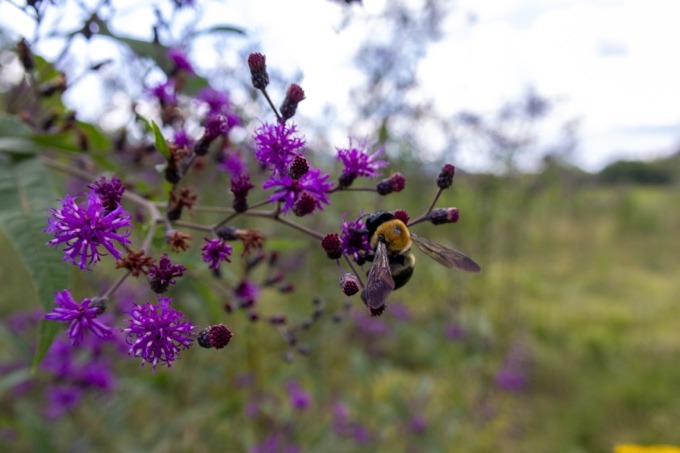


It wasn’t that long ago that fire didn’t need our help to crawl across the landscape. While there’s still some debate on the matter, a growing consensus points to lightning strikes as a natural igniter. In the growing season, the right strike of lightning could start a blaze that spread until rain or creek or otherwise dampened the creep of flames.
“There’s been some great work in the Florida panhandle, for example,” says Finch, who wrote the book on longleaf savannas, “demonstrating that lightning fires returned to longleaf savannas multiple times each decade even when humans were demonstrably absent from the landscape.”
Finch mentions contemporary accounts that suggest Native peoples may have burned the landscape around their villages in part to create a barrier for wildfire, and in part to improve forage and foraging, or for agriculture. But in much of the South, lightning fires were so common, there just wasn’t a lot of fuel left for people to burn.
Cecil Frost made the first estimate that lightning alone would account for fires on average three times each decade in coastal areas. Jean Huffman conducted the seminal research demonstrating the same occurrence in the Panhandle, except she showed that return intervals were great than three times each decade in many cases. The frequency and seasonal timing of the lightning fire regime would vary by forest type, local geography, and by latitude—the farther away from the coast, generally the less frequent the lightning.
Whether lightning or early management practices, things changed when cash crops and large plantations were established. Fire suppression became vital to protecting all that was being built. And the sweetgums and cedars and other woody plants crept in and snuffed out the airiness of the grass- and wildflower-dominant fields.
Today in places like Hellums, a 1,500-acre property with extensive forests, incredible cave systems, and actively managed open habitats in the Paint Rock Valley, restored and remnant grasslands need a regular dose of fire fed by a human hand to sustain the openness and diversity possible. There are a couple of typical burning windows. In plants’ dormant season—late winter to early spring—fire helps remove deep layers of fallen leaves from previous years and can help in the first stages of restoration. In the summer growing season, fire can make great strides in killing woody competitors and bringing a site back to grass and wildflower dominance.
That’s our goal on the Hellums property. On our early September burn day, the water truck we’d all been waiting for rolled into position. Three students and their instructor from the Alabama A&M FireDawgs joined the Research Center staff, ready to light up. The FireDawgs not only provide us the extra safety of more hands and eyes to keep the burn under control, but they also offer us the opportunity to share real-world training and experience with the next generation of land stewards and conservationists.

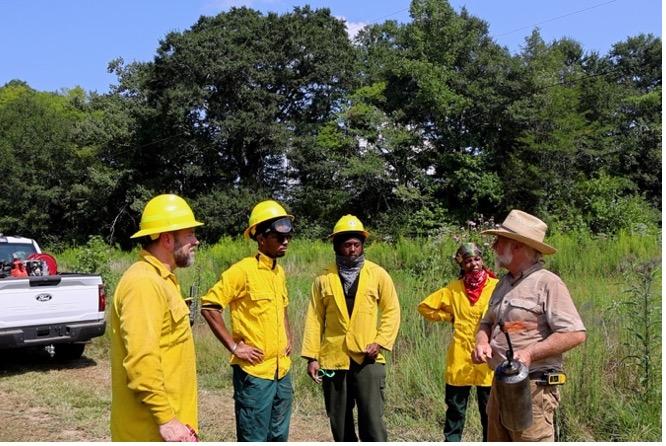


It’s ideal burn conditions when the wind is predictably blowing at a moderate speed from one direction. But as on most summer burn days, the wind was fickle, blowing from several directions; occasionally a good gust would get the fire moving. The humidity had dropped down to just about 30%, a rarity in the South. With a drip torch in hand, Finch dropped fire along the perimeter, passing the torch off later to a FireDawg to try his hand at directing fire under supervision. Low flames engulfed plants and set moisture in the plants sizzling. Columns of water vapor surged forth. The heat grew even more intense. Our crews walked the perimeter of the fire break to make sure no ember or spark went astray.
This correspondent here only lasted a couple hours in the throes of the fire and, more so, the sweltering heat. But our crew spent a good 8 hours that day directing the blaze across 150 acres or more. The result of their hard work is stark.
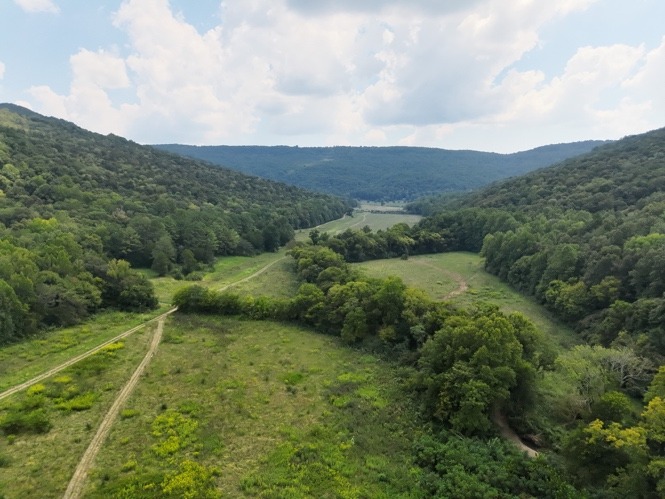
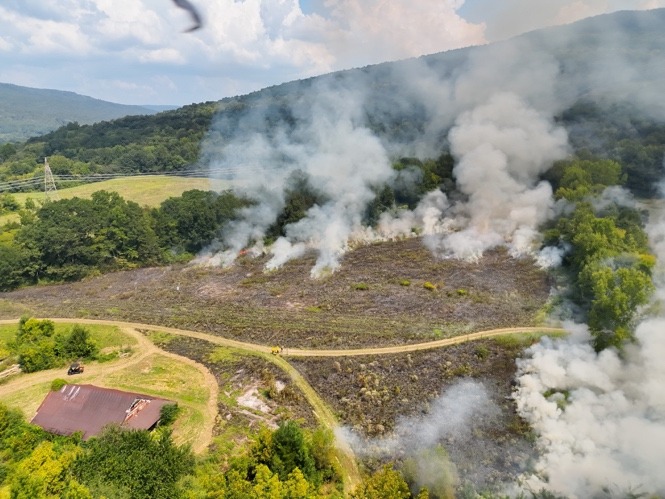
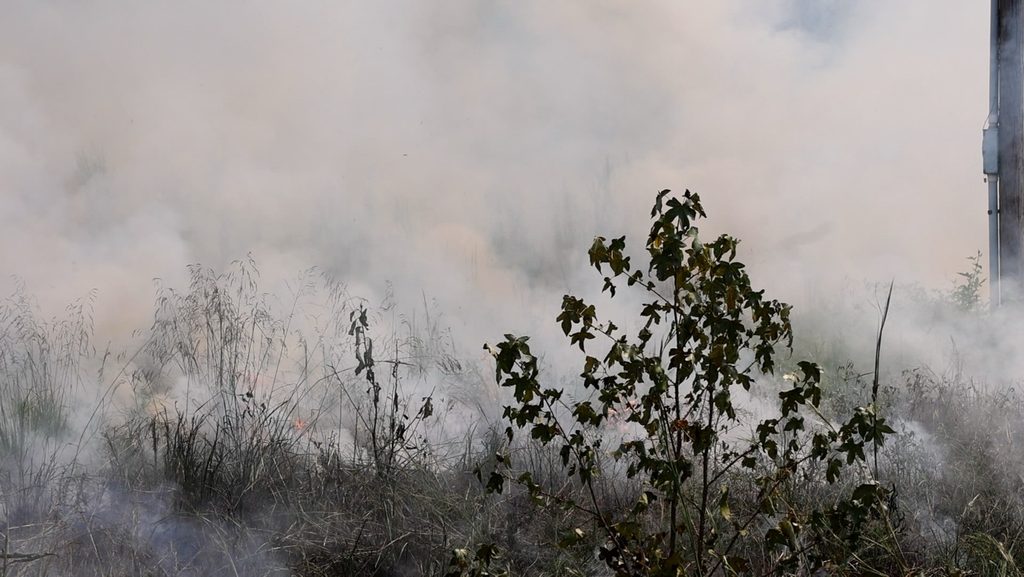
You may be scratching your head looking between the before and after burn photos. It does seem counterintuitive. Where there once were brilliant wildflowers and a mix of native grasses there now is charred earth. Yet, this burn knocked back the woody plants that had started to sneak into the landscape and would threaten to alter this habitat if left to its own devices. All this soil is open to sunlight now, and a diversity of seeds are already starting to sprout again. The beauty will be back. This October, some areas are already thick with green. More importantly, the health will be maintained.
And as we keep this habitat open and encourage more diversity of these cutthroat and bluestem and gamma grasses, of the goldenrods and milkweeds and more, we’ll begin to see the return of other important members of this grassland community—like turkey and quail. The landowners are excited about this; we hope you are too.
If you’re a student researcher interested in working with us to conduct biodiversity surveys before and after our future burns, reach out.