Our Companions of the Research Center: The Timber Rattlesnake

By Kelsey Barnett-Fischels, Communications Director

I don’t have a Paint Rock rattlesnake story. But after speaking with our center researchers and others for this week’s newsletter, I expect it won’t be long until I meet one of these venomous snakes. I look forward to it.

The eastern timber rattlesnake our center knows is not a vicious, slithering beast but rather a docile serpent of the forest. I hope you’ll take a moment to read these four rattlesnake stories and get to know more about this important member of our natural systems.
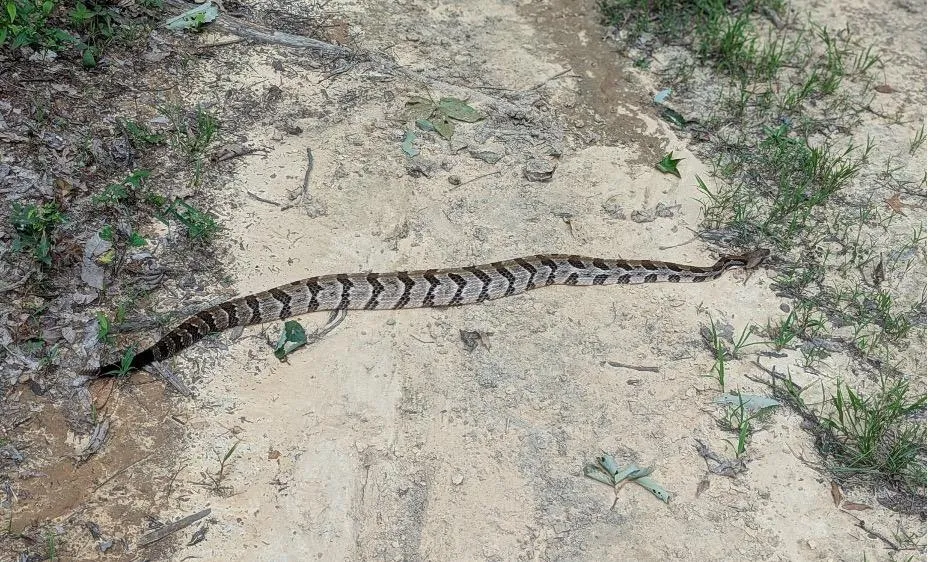
Photo by Brandon Renner, Paint Rock Research Center Research Technician and Shortleaf Program Manager. | Pictured: A rattlesnake with a large meal in its stomach backed against the bank, a less than ideal spot to digest that meal. Snakes typically don’t like to travel far after consuming such large prey items, as it makes them vulnerable to predation. Typically this snake would much more prefer the comfort of a burrow or a gap between rocks to digest a prey item of this size.

As Generous as a Rattlesnake

By Bill Finch, Founding Director, Paint Rock Research Center

I played with small snakes as a child. I even took a pocketful of earth snakes to church, as a sort of offering.

But I was raised to fear rattlesnakes and did to the point of not being able to speak when I saw one. Coming over a mountain one day, I looked out over a rocky western face gathering the first heat of spring and thought if I’m ever going to see a rattlesnake, it’s right now. Almost the moment I thought it, I saw the rattlesnake stretched leisurely along a rock, 10 feet away. Tired of fear, I sat down on a rock a few feet away, and we just looked at each other for half an hour or so. It occurred to me then that the last thing a rattlesnake wanted to do was put its mouth on a nasty human. 

In the 50 years since, I’ve stepped over, stepped around, and even crawled over eastern timber rattlers and diamondbacks, and their response has always been “generous … magnanimous,” as William Bartram described them during his famous 18th century explorations of the South.

We have a “tree of Paradise” on the preserve. It’s a persimmon, and one of several on the preserve that produce unusually large and desirable fruit. It shades a spring that emerges from a cliff shelter, and like many others—rabbits, raccoons, deer, bear, and thousands of years of people—we were attracted to that spring and its fruits. We set up cameras there with University of Alabama researchers, hoping to get a better handle on what was using this ancient thoroughfare of life, and four people and two dogs crossed and recrossed the spring beneath the tree dozens of times, occasionally stopping to eat a persimmon. Until Kendra Abbott, professional nature photographer, educator, and outdoor enthusiast, let out a Wisconsin “Whoa,” and there beneath the tree and our feet was a large rattlesnake, as insouciant as only a rattlesnake can be, waiting patiently for the commotion to die down so it could get back to business. We tended our cameras and left it in peace.

I reckon it’s possible to be bitten by an eastern timber rattler. But you have to try very hard. There are snake-handling churches in Northeast Alabama that testify to that. I remember two drunk men in Calhoun County who decided to pitch a rattlesnake back and forth. My dog tested one’s patience, got a nasty bite and an expensive trip to the vet, and hasn’t pestered one since. 

There’s a long tradition at Sharp-Bingham, dating decades before the research center was established here, that no rattlesnakes should ever be killed. The hunting club grumbled, but none was worse for leaving them alone. So yes, we have one of the healthiest populations of timber rattlers in North America. Please feel free to recommend us to your favorite “most snake-infested places” website. Rattlesnakes are our companions at the research center. We sometimes see the same rattlesnake for days at a time. We give them a friendly nod and names, and work around them, knowing they protect us as they protect the forest. And we know that if we can’t live with a creature as generous as a timber rattler, there’s no hope we’ll ever learn to live with nature.
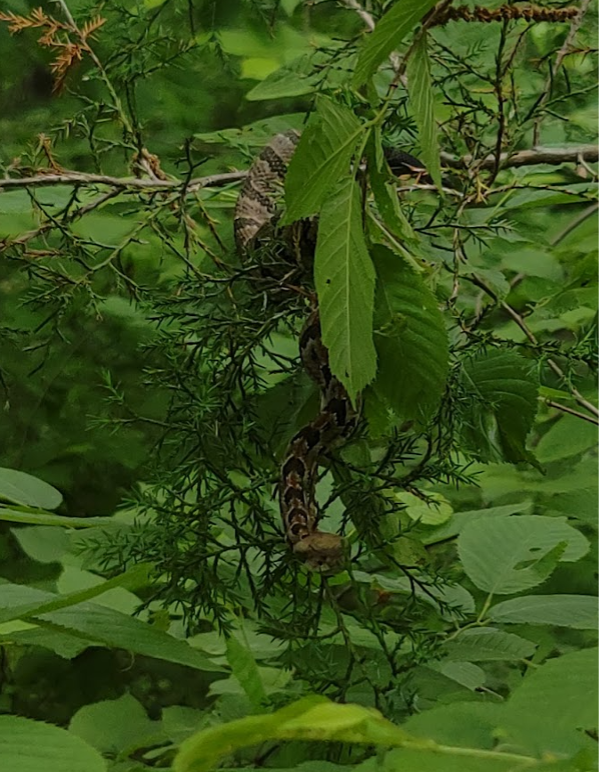
Photo by Helen Czech, Research Associate in Wildlife, Forestry, and Environmental Sciences Department of Natural Resources and Environmental Sciences, Alabama A&M University. | Pictured: A small-bodied juvenile rattlesnake exhibiting rarely observed canebrake behavior in a tree.

The Snake-Tree Quadrat

By Patience Knight, Field Coordinator/Wildlife Research Technician, Alabama A&M University

In summer of 2021, my colleague Helen Czech and I were taking a large group of student techs to the Paint Rock forest dynamics plot. I started with a tour of the plot and, of course, told them to expect to see venomous snakes. Sure enough, we came upon an adult rattler. All was well; they got their pictures, and we continued. 

Then I began training, while Helen went out to the far side of the plot on a separate assignment. As I was explaining to our crew how we process each quadrat, one of them asked about a snake she saw near one of the quadrat corners. It was a copperhead. So great! We’d seen the venomous snakes of Sharp-Bingham. I reminded them that this was what we expected and to just avoid that area. 

I proceeded to show them how we tag trees in each quadrat and walked up to a slender cedar sapling. There, at eye level, within its branches, I saw a small snake. I called the crew over to check it out and take pictures. Because of its dark color and patchy pattern, I figured it was a baby rat snake. As the techs took pictures, one said, “That’s definitely not a rat snake.” So I took a closer look at my pictures and finally saw two little buttons on the end of its tail.

At this point I was dumbfounded and at least two of our new hires were huddled together, literally side-eying me. They’d come to the conclusion that we’d brought them out to their doom, and they were ready to check out. I tried (rather unsuccessfully) to explain and quickly figured out I needed backup. 

I bellowed across the hollow to Helen. As a lapsed herpetologist (her words, not mine), I knew she could clear things up. This had to be a rare pygmy rattlesnake. This wasn’t normal. She’d be able to convince our skeptical crewmates that this was an anomaly.

When Helen finally got back to us and we showed her the snake in the tree, she stared a moment and simply responded with a, “Huh.” In her 20-plus years conducting fieldwork, she’d never seen a baby timber rattlesnake up in a tree like that. With her words, I was vindicated! The two skeptics decided to stick around, and we resumed training. But that baby rattler decided to spite us and was up higher in that little tree when we left for the day, only for us to find it even higher the next day. By the end of that second day, I had had enough. I decided to remind that rattler that it was terrestrial, not arboreal, and I used one of our extending poles to return it to its station. Ever since that day, that block of the plot is referred to as “Snake-tree.”
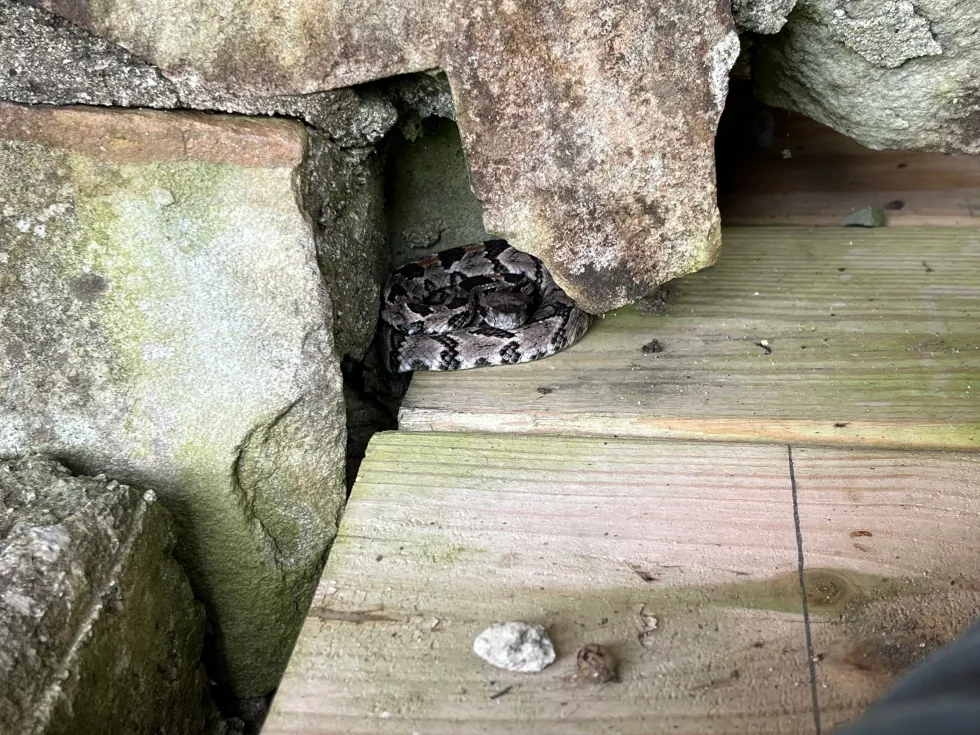
Photo by Nathan Paris, Forest Research Coordinator, Paint Rock Research Center

A Short Trip Across the Threshold

By Nathan Paris, Forest Research Coordinator, Paint Rock Research Center

Last September, I was walking up to the research center basement and reaching for the doorknob when I noticed a young timber rattler stretched out across the threshold. I can’t speak to the snake’s reaction to my approach, but I was certainly surprised, though I probably shouldn’t have been. The snake promptly moved to the side of the door and coiled, and I was able to safely pass and notify the other team members inside to exit carefully or use another door. To this day I continue to scan this area with greater scrutiny when entering or exiting through the basement door, always vigilant, always on the lookout for the beings we share this space with.
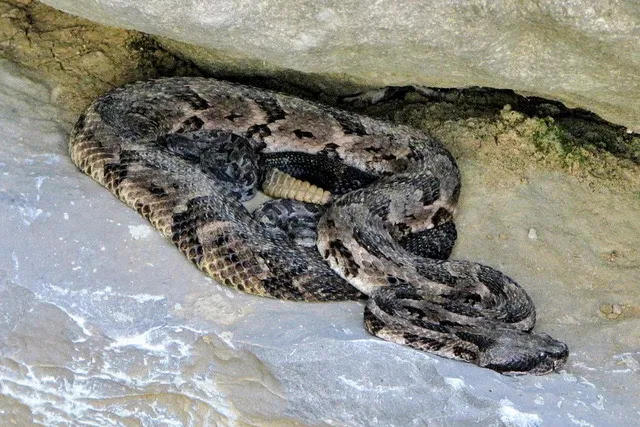
Photo by Horace Clemmons.

Respect the Rattler

Interview with Horace Clemmons, Previous Paint Rock Valley Resident, by Bill Finch

Horace Clemmons shares the blame for many things here at the research center. It was Horace who began assembling the properties that became the Sharp-Bingham Preserve. It was Horace who built the soaring residential facilities. It was Horace who negotiated sales to The Nature Conservancy and later the research center. 

And to a large degree, Horace is responsible for the respect that rattlesnakes enjoy on the property. He laid down the law for the hunting clubs.

“Look, I told them if they killed something they weren’t going to eat, they were out of the club,” Horace said. Apparently, none of the hunters were willing to consider rattlesnakes table fare, and Horace was clearly a more potent threat than the rattlesnakes.

“There were always a lot of them back there,” he said. The convoluted ins and outs of the limestone bluffs made excellent communal denning areas. The forest provided an abundance of fat pack rats, field mice and voles, rabbits, possums, an occasional bird. Modern human hunting habits may have inadvertently made life easier for the rattlers: When open feeding of deer was once permitted, it wasn’t unusual to find a big rattlesnake under a feed trough, waiting quietly for the squirrels and raccoons attracted to the fodder.

But it’s also clear that Horace had somewhat of a special affinity for the rattlesnakes. Horace studied their habits and was essentially our first rattlesnake researcher. Years before the majority of scientists came to the same conclusion, Horace saw that the parenting behavior of rattlers was more protective than many believed.

“I used to go for a walk every morning, and at that first culvert below the house, I noticed this big fat rattlesnake laying there, and she’s so plump I said she’s about to hatch off some babies.” 

“Hatch off” is a manner of speaking. As Horace is well aware, rattlesnakes don’t lay eggs, they live-birth fairly well developed young. Many once thought that the mother abandoned the young as soon as they were born. 

“And a week later I saw four or five little rattlesnakes around her, and they were there together for a week or so, and then one day I walked across the culvert and saw all these rattlesnake skins, and they were all gone.”

That was back in the early days of this century, and many doubted his observations. But he found an Arizona researcher who studied rattlesnake behavior. “He said, I don’t care what people say, these stick around to the first molt and then they leave.” Western rattlesnakes are different in many ways from the eastern species, but this behavior seems consistent. Nowadays, there’s not much argument that Horace was correct.

Naturally, Horace was the one everyone sought out when there was a rattlesnake in an awkward place. 

“There was one time Elizabeth (his wife) called, and said she thought there was a big branch across the road, and she wanted me to come get it. And by the time I got there, she realized it was a big rattlesnake.”

Horace picked it up as high as he could and he said it touched the ground. “That was the last snake I ever caught with my hands. You know you always have to shake them a bit (to keep them from coiling), and I was talking to Elizabeth and wasn’t paying attention and it was all wrapped around my arm, and I finally got enough unwound. I never caught another bare handed.”

“I told him I would divorce him if he did,” Elizabeth added.

Even Horace, tempter of fate, was never bitten. Elizabeth said she’d heard that sometime in the last century a Boy Scout had been bitten somewhere nearby. But with decades of activities of hunters, researchers, flower lovers, dogs, none had even been bitten by a rattlesnake, Horace said.

The Modus of Tracking Birds

By Mary Medlin, Avian Research Coordinator, with Kelsey Barnett-Fischels

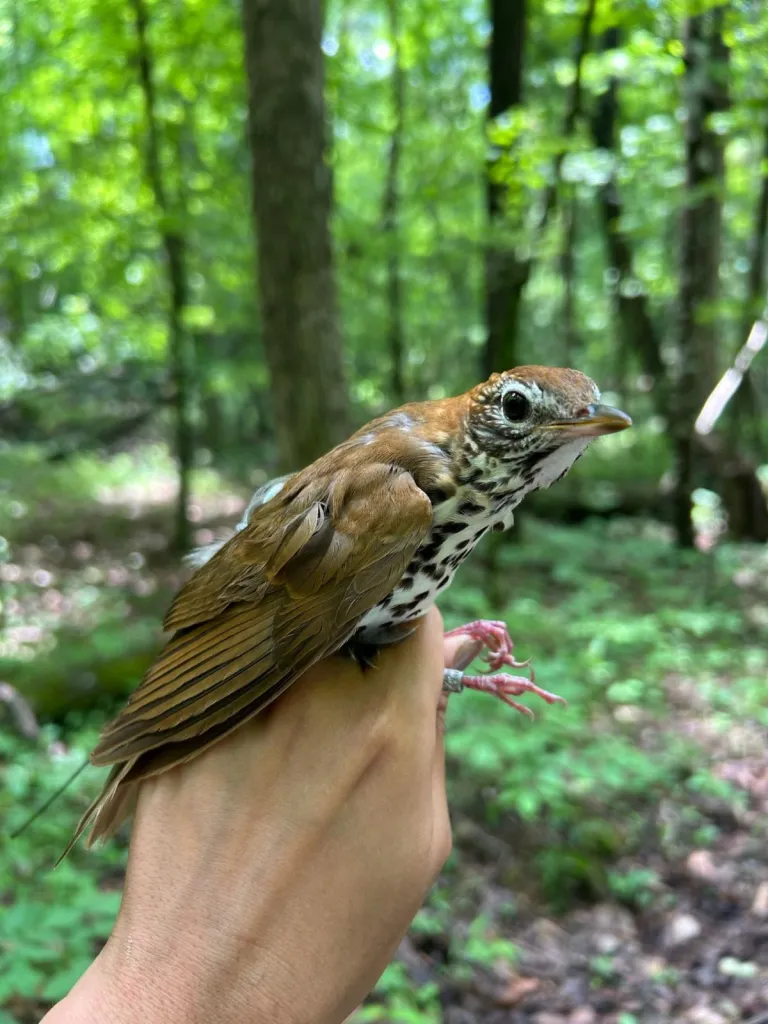
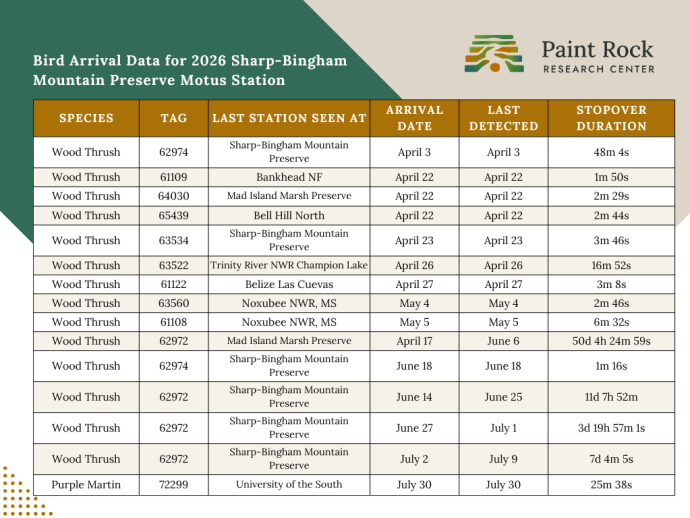
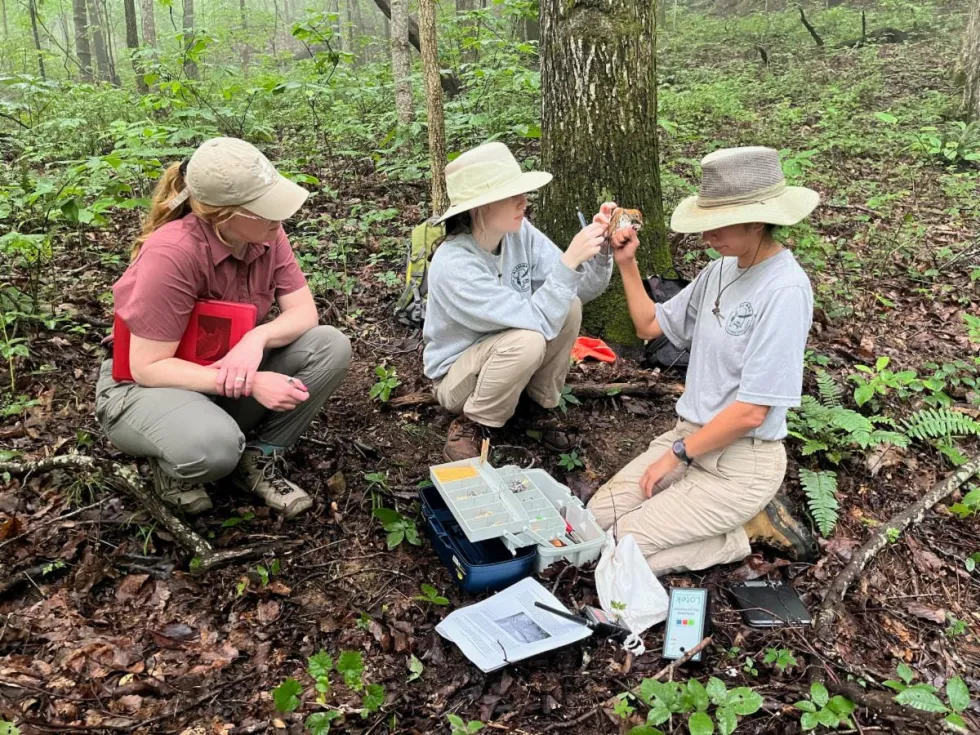
Bird No. 62972 seems to like the Paint Rock ecosystem. Since we tagged this male wood thrush last year—even despite our disturbing him with our human hands—he’s stuck around. We delight in his melodious flute-like trills, which are easier to hear than it is to see this near-threatened species. But we don’t have to see No. 62972 to know he’s around. We’re able to track his busy movements through our dense, expansive forest with our Motus station.

The Motus Wildlife Tracking System is a global research network that uses radio telemetry towers to pick up signals of geolocator tags attached to anything from rodents to insects to birds. We feel lucky to have a station at the Paint Rock Research Center, supported by the Alabama Department of Conservation and Natural Resources. With only about 11 stations in the whole state of Alabama, we help fill a detection gap for birds and other small species researchers and conservationists are following. We gain more-complete migration data. We detect species that are often hard to see or hear. And we provide insight to the presence of birds and more in our area of undisturbed but remote habitat. Plus, the Motus database is open-access and easy for anyone to use.

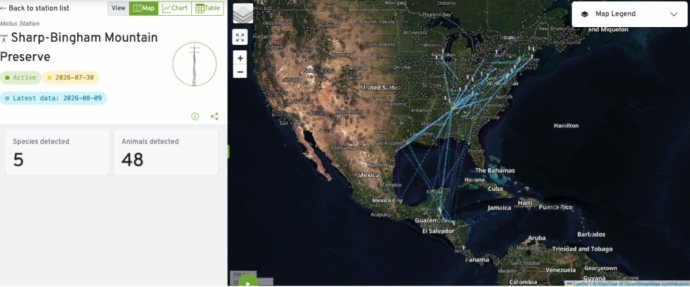
Our team installed the Sharp-Bingham Mountain Preserve Motus station with researchers from University of Tennessee Chattanooga and Alabama A&M University in 2024. Since then, we’ve detected 48 total individuals across 5 species. Most are birds, such as the eastern whip-poor-will and the sharp-shinned hawk, but we have also detected gray myotis—small bats that are being tagged by our friends at the University of Tennessee Chattanooga.

This season, we were excited to see the amount of returning tagged birds from our previous seasons. No. 62972 wasn’t the only bird to come back. No. 62974 did, too. He was born and tagged here last year, and he is one of the lucky few juveniles that make it through their first year. Now, he stands a much better chance of surviving and returning over the next few years. This site fidelity speaks a lot to the habitat quality here at Paint Rock—and also to birds’ amazing ability to navigate to sites that offer plentiful forage and habitat year after year.

At the end of July, we picked up a new species, too: a purple martin. This individual was tagged in Nashville in June of this year and has been bouncing between ours and a handful of other stations in northeastern Georgia and southern Tennessee. It could be visiting to fuel up on insects for migration or to prospect nesting grounds for next year. It would find plenty of company in the bustling colony of purple martins that our neighbors maintain, so we’ll be looking out for a ping from it come spring.

Wood thrush with a Motus tag and federal band attached.
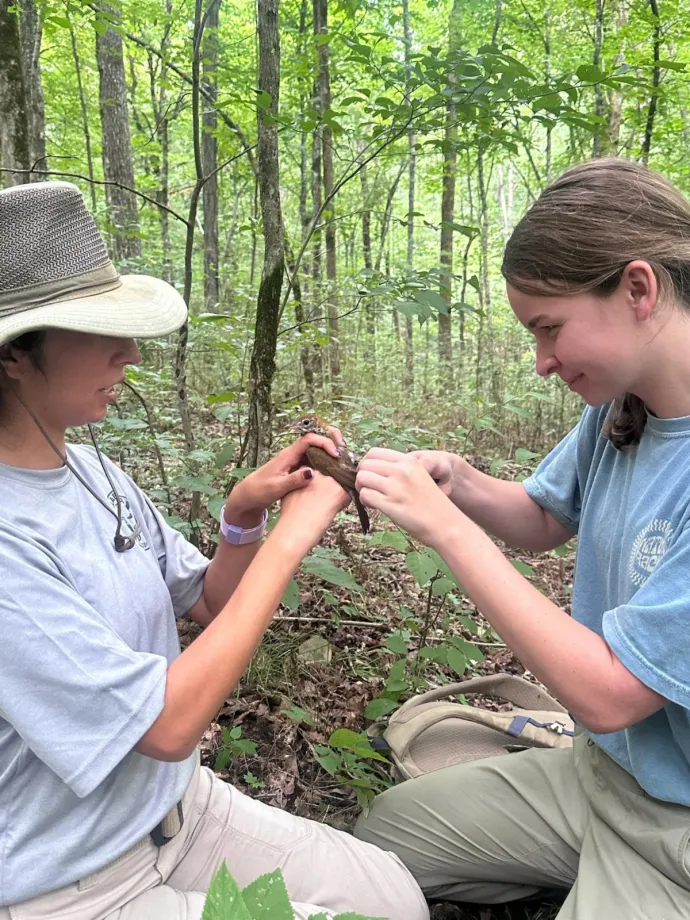
ADCNR biologist Mercedes Maddox and PRRC reseracher Mary Medlin fitting wood thrush with tags.
ADCNR biologists and PRRC staff waiting for wood thrush to fly into a mist net.

Access Motus Data on Your Own

You don’t have to be a scientist to view and follow along with Motus data. To keep up with our Motus station data and more:

  1. Visit motus.org
  2. Click “Explore Motus data” > Continue
  3. Select “Stations” at the left (or explore data by species or projects!)
  4. Search for or zoom in on the map to the station you’re interested in observing
  5. Click “View Station

From here, you can see the flight patterns and movement of species our station has picked up, as well as view a chart or table of the different species that have flown past the tower. There are a number of filtering option as well for species and animals, projects, time duration, and more.

Have a Project Idea?

If there are any scientists reading, we are always on the lookout for more collaborations that tap into our tagging and Motus station efforts. If you and your team have a project in mind, please reach out to us here.  

*Note: All banding, marking, and sampling is being conducted under a federally authorized Bird Banding Permit issued by the U.S. Geological Survey’s BBL.

The Odyssey of Yellowwood

We went deep into Paint Rock with Penn State researchers to track the million-year journey of this mysterious Southeastern tree

By Bill Finch, Founding Director

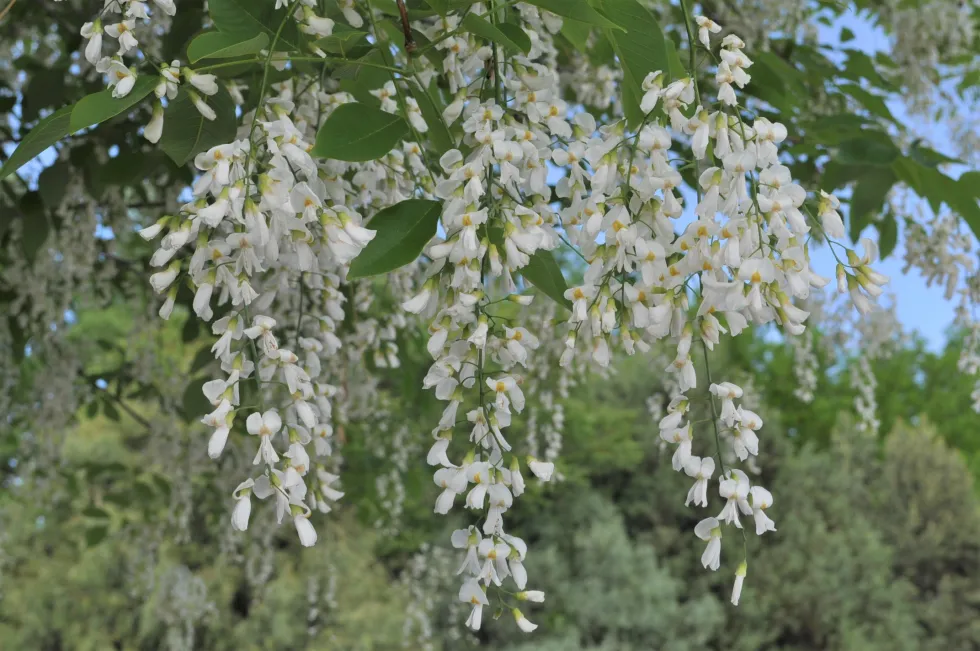
Imagine a bean that became a 60-foot tree, with hanging clusters of wisteria-like flowers in May, smooth and smokey gray bark, and golden-yellow wood. 

There are many features of the tree we call yellowwood that make it unforgettable. But many never see one. Yellowwood (Cladrastis kentukea) is rare enough and becoming rarer each year. But most importantly, it’s very picky about where it grows. Like many rare species in Paint Rock, it’s restricted to unexplained forest islands, widely scattered through the southern and central U.S. and isolated within the ocean of more common eastern forest trees. If you looked at the range of yellowwood on a map of eastern North America, it would look much like the patterns of remote islands in the Pacific, so far apart you can’t imagine how the trees could have hopped from one place to another.

Yellowwood is one of the mysteries of the modern forest that can only be explained by understanding how our forests have changed over millions of years. Was yellowwood always this rare and scattered? Or was it widespread and common before something caused it to retreat to these small islands within the larger forest? What something was it?

By understanding yellowwood and its rare forest island companions—like smoketrees, limerock arrowwood, Alabama snowwreath, and other trees and shrubs rarely seen outside of refuges like Paint Rock—we may better understand how future changes may shape our forests.

Photos courtesy of Austin H. Parr, Lab Manager, Pennsylvania State University and
Emily Scott, Ecology Program, MS Student, Pennsylvania State University

That’s why it was such a pleasure to host Penn State University researchers Austin Parr and Emily Scott, who have spent weeks this summer touring these yellowwood islands. Naturally, they wanted specimens from the southernmost populations in Alabama, where yellowwood has been hiding out perhaps longer than anywhere else in North America.

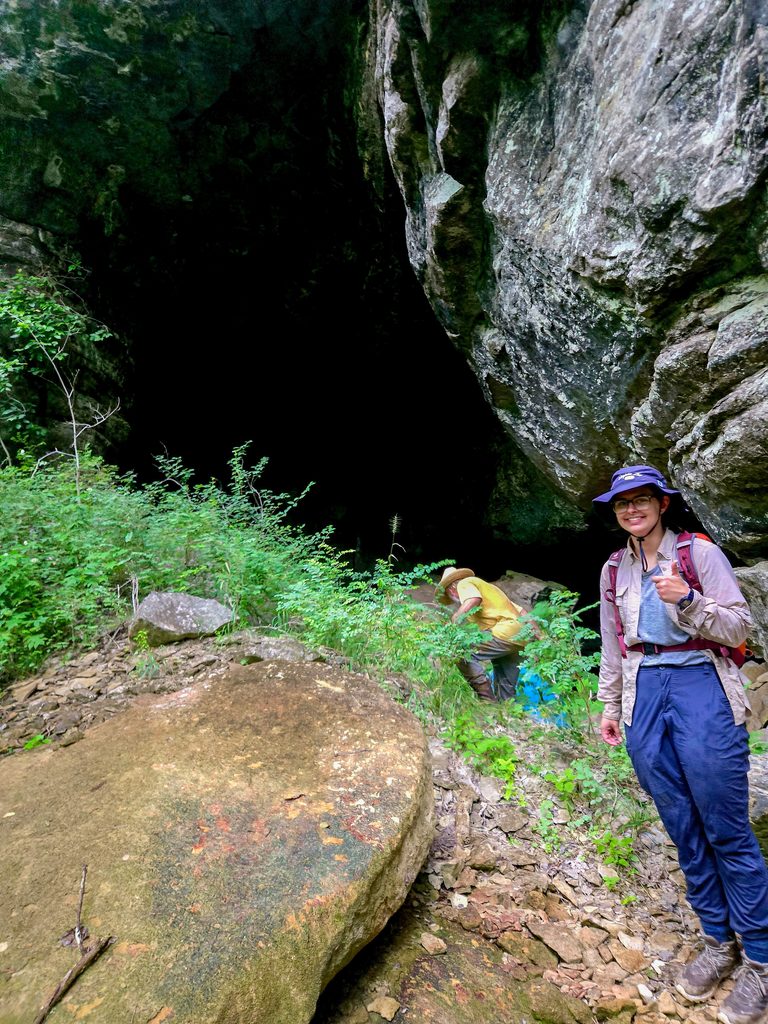
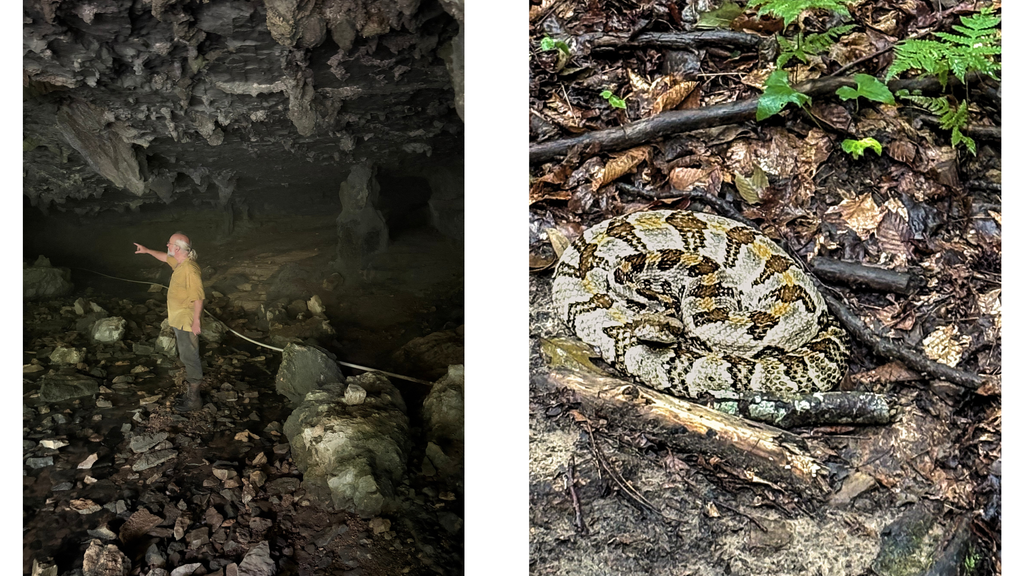
Handsome specimens of yellowwood can still be found at the Sharp-Bingham Preserve, which we help manage with The Nature Conservancy. But as is the case everywhere I’ve ever seen it, getting there is an adventure bordering on an ordeal. In the South, yellowwood seems to thrive only where steep, unstable limestone slopes create a break in the forest canopy. We climbed, slid, tumbled down some of the preserve’s steepest slopes on a day so warm and humid the forest seemed to be sweating. At times, Emily and Austin had to cling to the trees they were sampling to avoid slipping farther down the slope. And just as the tropicalness of the Paint Rock summer seemed overwhelming, the sky broke, and we found shelter from the rains in the coolness of one of Paint Rock’s largest and most spectacular caves.

Photos courtesy of Austin H. Parr, Lab Manager, Pennsylvania State University and Emily Scott, Ecology Program, MS Student, Pennsylvania State University

We brought back DNA specimens of 14 yellowwood, another sighting of Paint Rock’s rare “extinct” hawthorn, plenty of ticks and chiggers, and an encounter with a large and strangely pale timber rattler. To see yellowwood, sometimes you have to really want to.

This won’t be the last you hear about yellowwood. We had a conversation with HudsonAlpha Biotechnology Institute, and we all agreed that a more detailed effort to undercover the tree’s whole genome, rather than just snippets, will be necessary for the future of this work. We’ll be working with all concerned to understand what yellowwood can tell us about the history and future of eastern forests.

The Weight of Insects

By Kelsey Barnett-Fischels

We don’t allow camping at Paint Rock Research Center, for many reasons. Yet, since 2024, from early May to June, a tent-like structure has appeared in one of our meadows. This tent isn’t for a campout—rather it’s a Malaise trap for collecting small creatures with big implications for life on this Earth.

Photo by Kendra Abbott

Kendra and John Abbott, professional nature photographers, educators, and outdoor enthusiasts both with roles at The University of Alabama, are supporting a national effort to study insect trends. Along with more than 150 other researchers, the Abbotts are gathering insect biomass and diversity insights from two collection sites across Alabama for the last couple years.

“Insects affect everything,” Kendra says. “Their decline is directly related to our survival.” 

Dr. Peter Dunn, biologist from the University of Wisconsin Milwaukee, began this North American–focused study in 2019. Based on an insect biomass study that documented an alarming 75% decline in insect mass in Europe over 27 years, Dunn wanted to develop a standardized method for tracking insect trends in North America. Biomass—the number of insects found in the collections—are of interest, but Dunn also wants to understand the extent of insect biodiversity, too.

In 2024, the Abbotts saw the call for researchers to join this North American Insect Abundance Network. They noticed a gap in data for the Southeast that they wanted to help resolve, and Paint Rock became a key site for their project because of the amount of biodiversity already present. “A place with strong biodiversity all starts with geology and then moves up from there with plants and insects and everything else,” Kendra says.

Even two years ago, as teams collected insects, the amount of biomass proved so abundant that it became stressful to process. Now the Abbotts and others across the U.S. are already noting a drastic decline. “Last year was a breeze to process,” Kendra says. “There weren’t that many insects. This year is going to be even quicker.”

“Insects affect everything. Their decline is directly related to our survival.”

— Kendra Abbott 

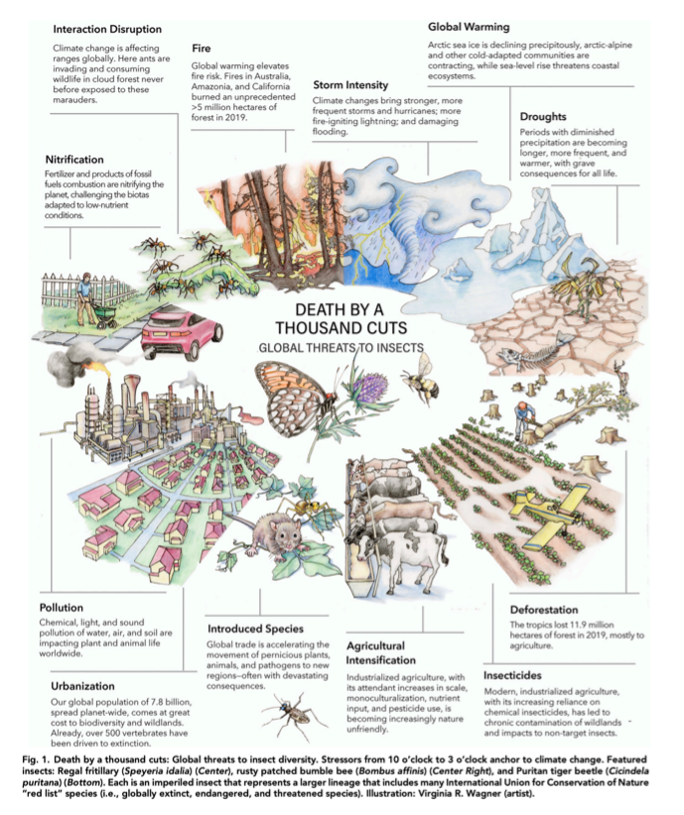
Graphic from “Insect decline in the Anthropocene: Death by a thousand cuts,”
David L. Wagner et al.

Insect declines do not have a single culprit but rather should be thought of as “death by 1,000 cuts”: many overlapping pressures that chip away at populations. Large‑scale agriculture and the heavy use of herbicides and pesticides, combined with the chemicals people put on their own lawns and gardens, strip away both insects and the plants they rely on. At the same time, habitat loss from logging and development, climate change, increasing light pollution, and more frequent extreme weather events—like hard freezes after warm spells or torrential rains and flooding—kill insects directly and weaken populations over time. Any one of these stressors might be manageable, Kendra says, but together they leave insects struggling to survive and recover.

As biomass has declined overall, the Abbotts’ team has also noticed an interesting shift in insect species distribution, where the amount of one species masks a striking loss in biodiversity with a sheer amount of its biomass. The Diptera group, which includes true flies like bee flies, tachinid flies (commonly mistaken for wasps), and assassin flies, has overtaken some samples—so much so that their bodies have overflowed the petri dishes as the Abbotts and their team sorted samples. Hymenoptera (wasps, bees, sawflies, and ants), Coleoptera (beetles), and moths, too, have shown peaks in samples at different times. Kendra says these single-species abundance they have been seeing is likely due to the species having a good year from a specific microclimate condition that the group needs. 

The Abbotts rarely see butterflies, though in the past, Paint Rock has been well-known for butterflies. Nor do they see many Nematocera, a group that includes mosquitoes and crane flies, which are especially important for bird reproduction and fledgling rearing because of their high omega 3 fatty acid content. And the overall picture from the data, similar to Europe’s, is revealing a disturbing trend of loss for a body of creatures essential to most life on this planet.

With something as widespread and vital as insects, you do not have to be at the same level of research and conservation as Paint Rock Research Center to have a positive impact. Kendra emphasizes, “Adding anything you can to your yard that insects can come to visit for pollen or nectar—just little steps like that—can make huge differences in insect biomass.” Native plants are best, like black-eyed Susans and Texas star hibiscus, which are easier to find at local nurseries, but some non-native plants can also provide food for insects, too, such as zinnias, squashes, and lantana.