By Kelsey Barnett-Fischels, Communications Director
I don’t have a Paint Rock rattlesnake story. But after speaking with our center researchers and others for this week’s newsletter, I expect it won’t be long until I meet one of these venomous snakes. I look forward to it.
The eastern timber rattlesnake our center knows is not a vicious, slithering beast but rather a docile serpent of the forest. I hope you’ll take a moment to read these four rattlesnake stories and get to know more about this important member of our natural systems.
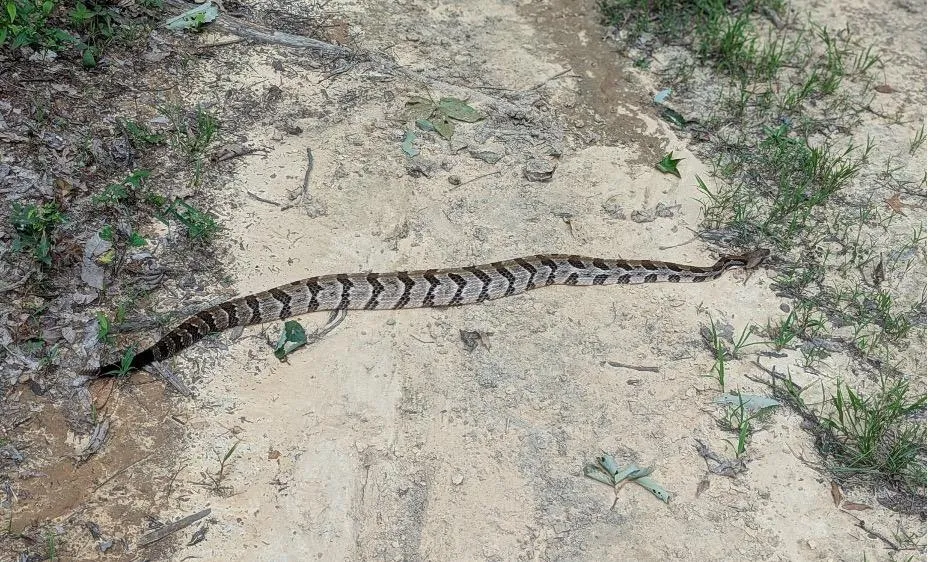
As Generous as a Rattlesnake
By Bill Finch, Founding Director, Paint Rock Research Center
I played with small snakes as a child. I even took a pocketful of earth snakes to church, as a sort of offering.
But I was raised to fear rattlesnakes and did to the point of not being able to speak when I saw one. Coming over a mountain one day, I looked out over a rocky western face gathering the first heat of spring and thought if I’m ever going to see a rattlesnake, it’s right now. Almost the moment I thought it, I saw the rattlesnake stretched leisurely along a rock, 10 feet away. Tired of fear, I sat down on a rock a few feet away, and we just looked at each other for half an hour or so. It occurred to me then that the last thing a rattlesnake wanted to do was put its mouth on a nasty human.
In the 50 years since, I’ve stepped over, stepped around, and even crawled over eastern timber rattlers and diamondbacks, and their response has always been “generous … magnanimous,” as William Bartram described them during his famous 18th century explorations of the South.
We have a “tree of Paradise” on the preserve. It’s a persimmon, and one of several on the preserve that produce unusually large and desirable fruit. It shades a spring that emerges from a cliff shelter, and like many others—rabbits, raccoons, deer, bear, and thousands of years of people—we were attracted to that spring and its fruits. We set up cameras there with University of Alabama researchers, hoping to get a better handle on what was using this ancient thoroughfare of life, and four people and two dogs crossed and recrossed the spring beneath the tree dozens of times, occasionally stopping to eat a persimmon. Until Kendra Abbott, professional nature photographer, educator, and outdoor enthusiast, let out a Wisconsin “Whoa,” and there beneath the tree and our feet was a large rattlesnake, as insouciant as only a rattlesnake can be, waiting patiently for the commotion to die down so it could get back to business. We tended our cameras and left it in peace.
I reckon it’s possible to be bitten by an eastern timber rattler. But you have to try very hard. There are snake-handling churches in Northeast Alabama that testify to that. I remember two drunk men in Calhoun County who decided to pitch a rattlesnake back and forth. My dog tested one’s patience, got a nasty bite and an expensive trip to the vet, and hasn’t pestered one since.
There’s a long tradition at Sharp-Bingham, dating decades before the research center was established here, that no rattlesnakes should ever be killed. The hunting club grumbled, but none was worse for leaving them alone. So yes, we have one of the healthiest populations of timber rattlers in North America. Please feel free to recommend us to your favorite “most snake-infested places” website. Rattlesnakes are our companions at the research center. We sometimes see the same rattlesnake for days at a time. We give them a friendly nod and names, and work around them, knowing they protect us as they protect the forest. And we know that if we can’t live with a creature as generous as a timber rattler, there’s no hope we’ll ever learn to live with nature.
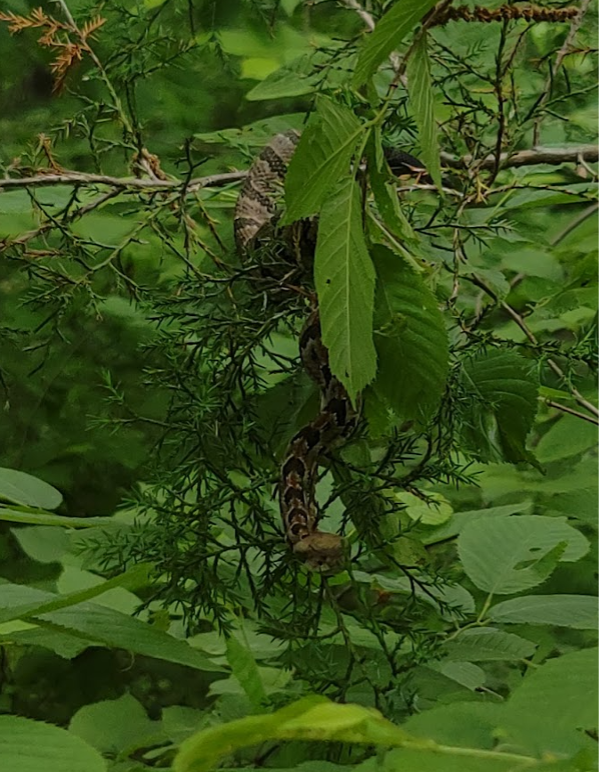
The Snake-Tree Quadrat
By Patience Knight, Field Coordinator/Wildlife Research Technician, Alabama A&M University
In summer of 2021, my colleague Helen Czech and I were taking a large group of student techs to the Paint Rock forest dynamics plot. I started with a tour of the plot and, of course, told them to expect to see venomous snakes. Sure enough, we came upon an adult rattler. All was well; they got their pictures, and we continued.
Then I began training, while Helen went out to the far side of the plot on a separate assignment. As I was explaining to our crew how we process each quadrat, one of them asked about a snake she saw near one of the quadrat corners. It was a copperhead. So great! We’d seen the venomous snakes of Sharp-Bingham. I reminded them that this was what we expected and to just avoid that area.
I proceeded to show them how we tag trees in each quadrat and walked up to a slender cedar sapling. There, at eye level, within its branches, I saw a small snake. I called the crew over to check it out and take pictures. Because of its dark color and patchy pattern, I figured it was a baby rat snake. As the techs took pictures, one said, “That’s definitely not a rat snake.” So I took a closer look at my pictures and finally saw two little buttons on the end of its tail.
At this point I was dumbfounded and at least two of our new hires were huddled together, literally side-eying me. They’d come to the conclusion that we’d brought them out to their doom, and they were ready to check out. I tried (rather unsuccessfully) to explain and quickly figured out I needed backup.
I bellowed across the hollow to Helen. As a lapsed herpetologist (her words, not mine), I knew she could clear things up. This had to be a rare pygmy rattlesnake. This wasn’t normal. She’d be able to convince our skeptical crewmates that this was an anomaly.
When Helen finally got back to us and we showed her the snake in the tree, she stared a moment and simply responded with a, “Huh.” In her 20-plus years conducting fieldwork, she’d never seen a baby timber rattlesnake up in a tree like that. With her words, I was vindicated! The two skeptics decided to stick around, and we resumed training. But that baby rattler decided to spite us and was up higher in that little tree when we left for the day, only for us to find it even higher the next day. By the end of that second day, I had had enough. I decided to remind that rattler that it was terrestrial, not arboreal, and I used one of our extending poles to return it to its station. Ever since that day, that block of the plot is referred to as “Snake-tree.”
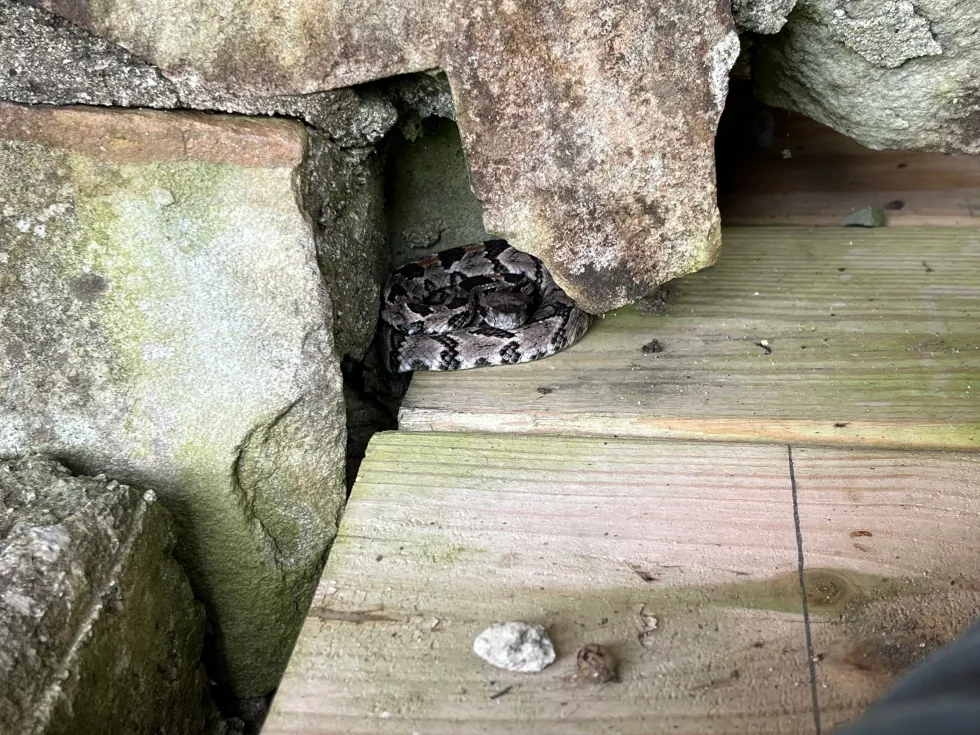
A Short Trip Across the Threshold
By Nathan Paris, Forest Research Coordinator, Paint Rock Research Center
Last September, I was walking up to the research center basement and reaching for the doorknob when I noticed a young timber rattler stretched out across the threshold. I can’t speak to the snake’s reaction to my approach, but I was certainly surprised, though I probably shouldn’t have been. The snake promptly moved to the side of the door and coiled, and I was able to safely pass and notify the other team members inside to exit carefully or use another door. To this day I continue to scan this area with greater scrutiny when entering or exiting through the basement door, always vigilant, always on the lookout for the beings we share this space with.
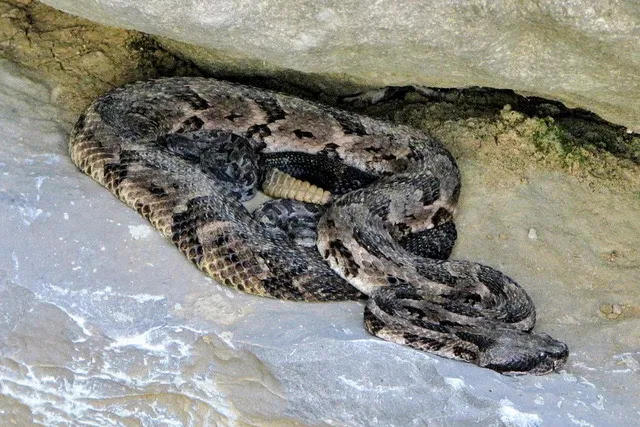
Respect the Rattler
Interview with Horace Clemmons, Previous Paint Rock Valley Resident, by Bill Finch
Horace Clemmons shares the blame for many things here at the research center. It was Horace who began assembling the properties that became the Sharp-Bingham Preserve. It was Horace who built the soaring residential facilities. It was Horace who negotiated sales to The Nature Conservancy and later the research center.
And to a large degree, Horace is responsible for the respect that rattlesnakes enjoy on the property. He laid down the law for the hunting clubs.
“Look, I told them if they killed something they weren’t going to eat, they were out of the club,” Horace said. Apparently, none of the hunters were willing to consider rattlesnakes table fare, and Horace was clearly a more potent threat than the rattlesnakes.
“There were always a lot of them back there,” he said. The convoluted ins and outs of the limestone bluffs made excellent communal denning areas. The forest provided an abundance of fat pack rats, field mice and voles, rabbits, possums, an occasional bird. Modern human hunting habits may have inadvertently made life easier for the rattlers: When open feeding of deer was once permitted, it wasn’t unusual to find a big rattlesnake under a feed trough, waiting quietly for the squirrels and raccoons attracted to the fodder.
But it’s also clear that Horace had somewhat of a special affinity for the rattlesnakes. Horace studied their habits and was essentially our first rattlesnake researcher. Years before the majority of scientists came to the same conclusion, Horace saw that the parenting behavior of rattlers was more protective than many believed.
“I used to go for a walk every morning, and at that first culvert below the house, I noticed this big fat rattlesnake laying there, and she’s so plump I said she’s about to hatch off some babies.”
“Hatch off” is a manner of speaking. As Horace is well aware, rattlesnakes don’t lay eggs, they live-birth fairly well developed young. Many once thought that the mother abandoned the young as soon as they were born.
“And a week later I saw four or five little rattlesnakes around her, and they were there together for a week or so, and then one day I walked across the culvert and saw all these rattlesnake skins, and they were all gone.”
That was back in the early days of this century, and many doubted his observations. But he found an Arizona researcher who studied rattlesnake behavior. “He said, I don’t care what people say, these stick around to the first molt and then they leave.” Western rattlesnakes are different in many ways from the eastern species, but this behavior seems consistent. Nowadays, there’s not much argument that Horace was correct.
Naturally, Horace was the one everyone sought out when there was a rattlesnake in an awkward place.
“There was one time Elizabeth (his wife) called, and said she thought there was a big branch across the road, and she wanted me to come get it. And by the time I got there, she realized it was a big rattlesnake.”
Horace picked it up as high as he could and he said it touched the ground. “That was the last snake I ever caught with my hands. You know you always have to shake them a bit (to keep them from coiling), and I was talking to Elizabeth and wasn’t paying attention and it was all wrapped around my arm, and I finally got enough unwound. I never caught another bare handed.”
“I told him I would divorce him if he did,” Elizabeth added.
Even Horace, tempter of fate, was never bitten. Elizabeth said she’d heard that sometime in the last century a Boy Scout had been bitten somewhere nearby. But with decades of activities of hunters, researchers, flower lovers, dogs, none had even been bitten by a rattlesnake, Horace said.