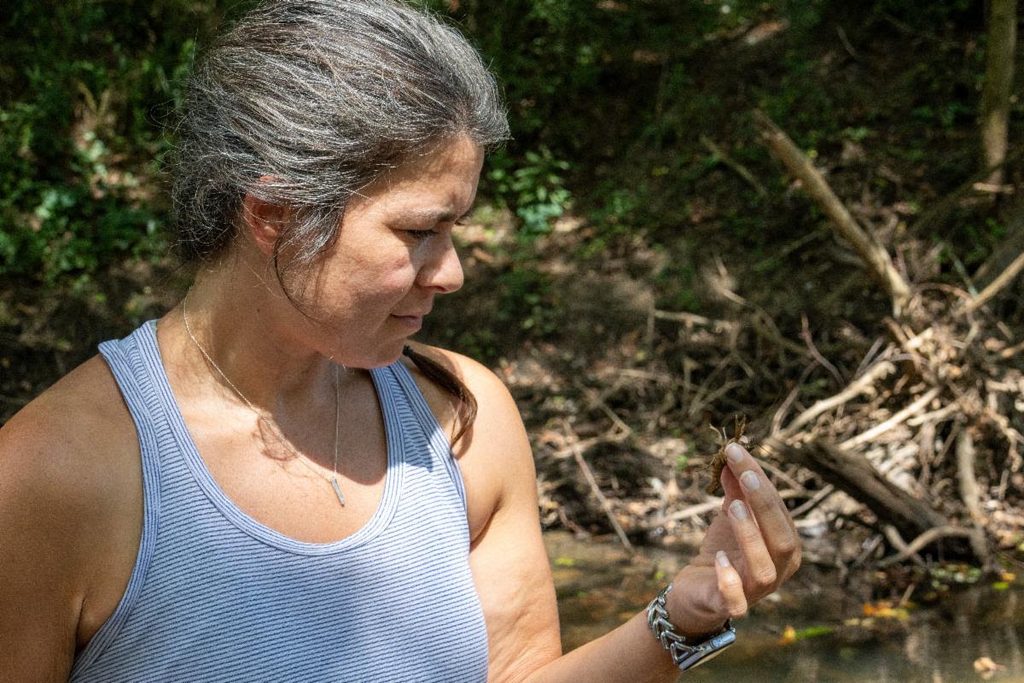
By Lilly Roehrig, Guest Author, Graduate Student, Environment & Natural Resources, Department of Geography, University of Alabama
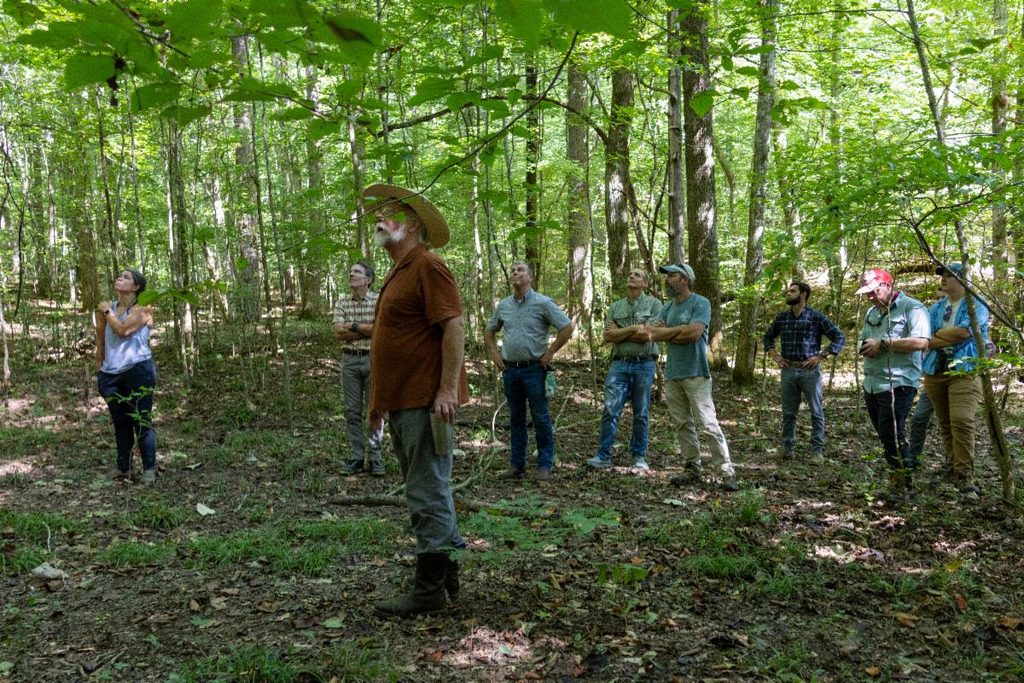
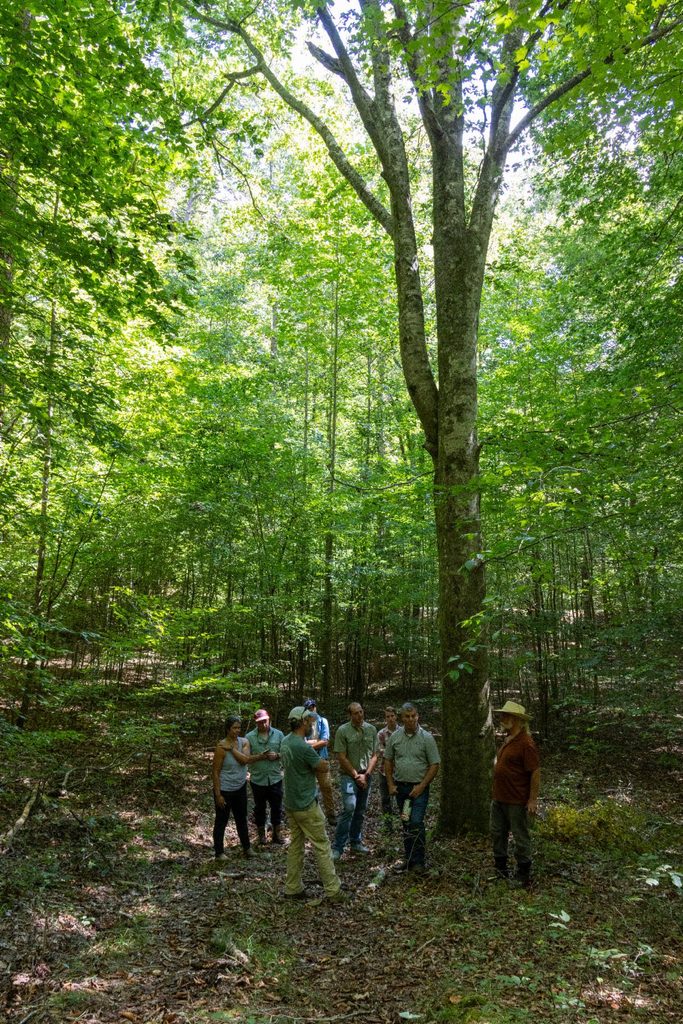
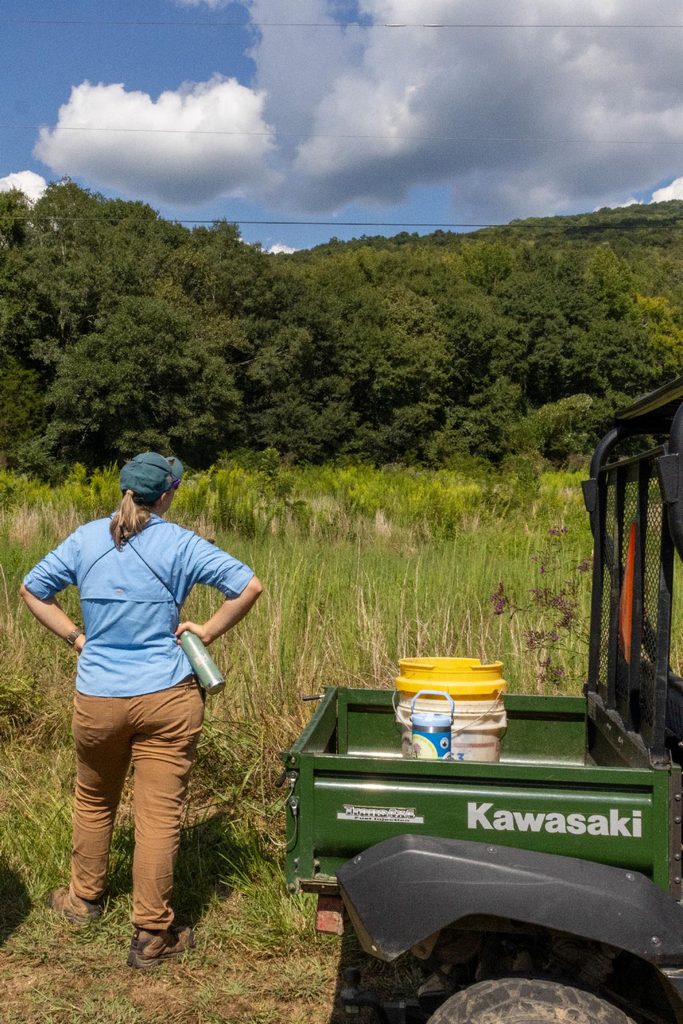
From the moment I rumbled into the Paint Rock forest on an ATV, I was in awe of the thousands of shades of green that each tree contributed to the rippling mosaic of the forest. One might assume that the years and disturbance events those trees have survived are lost to the passage of time, but our crew knew better. There is a secret history to be discovered beneath Paint Rock’s broadleaf canopy, and that very day we were beginning our journey to uncover it.
As a University of Alabama graduate student researcher in Justin Hart’s Forest Dynamics Lab, I’ve had the opportunity to work on a variety of projects across Alabama and Tennessee that address pertinent forest management issues using science-based solutions, with a particular focus on forest stand dynamics and silviculture. Our work at Paint Rock in July of 2026 was one of these projects, fully funded by the Paint Rock Research Center (with a grant from the Tom Sardy Foundation).

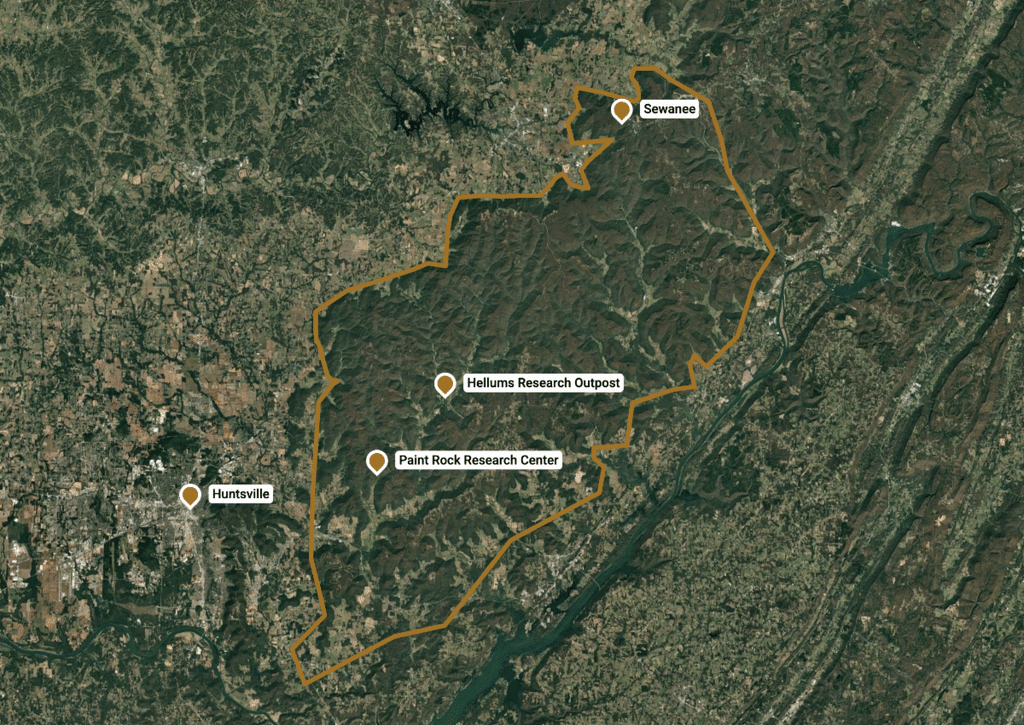
Our lab set out to core over a thousand trees in the 60-hectare Paint Rock forest dynamics plot to begin to build a story of their past. Kana Furukawa, my fellow graduate student researcher and leader of our fieldwork at Paint Rock, describes the project as a “…spatiotemporal analysis of canopy disturbances and tree establishment” that will “… add context to our understanding of the relationships between canopy disturbances and regeneration across spatial scales.”
By adding data to the pre-existing forest census dataset via tree ages and growth rates, we can reconstruct the establishment patterns of trees and identify canopy disturbance events, such as tornadoes or ice storms, that have influenced stand development and succession. Along with determining a tree’s age by dating the rings of a sample, we can also view other information, such as anomalous growth changes, that may indicate when and where the canopy was disturbed.
Together, these data allow us to reconstruct the forest’s history and identify patterns of disturbance and regeneration across time. This will help guide future conservation and management decisions, and the information can also support future ecological research at Paint Rock.

However, before this history could be read, we had to collect the tree core samples from several species. By coring more than a thousand trees, we’re able to reconstruct disturbance patterns across the entire study area and glean a broader context of how different species and stands responded to disturbances through time.
With increment borers—which consist of three main components: the bit, the handle, and the spoon—we collected our samples. As we pressed the tip against the tree and turned the handle clockwise, the bit caught on the bark and began to burrow into the tree. While we continued to turn, the wooden core was carved out. Once we cored far enough into the tree to hit the pith (the “center” of the tree), we inserted the spoon and turned the borer counterclockwise to remove the bit. The spoon—a narrow, cup-shaped piece of metal—was slid inside the hollow bit, and when removed, it contained the core. We inserted the cores into a paper straw for transportation, labeled with its corresponding forest dynamics tree ID number.

Tree cores can range anywhere from a few centimeters to several decimeters or longer, depending on the tree diameter, but the process does not harm the tree. Many trees have the ability to quickly respond to small wounds such as those that coring causes, which are only a few millimeters in diameter, and long-term studies have shown that coring does not significantly impact tree mortality.
As we worked, I learned that tree coring is as much an art as it is a science. Feeling the tethering bite of the bit as it catches into the smooth bark of a maple or knowing when to pull out of an oak with a rotten center were skills that took me many field days to master. As a crew, we grew faster, stronger, and more efficient at our tasks as time went on, and soon the creaking of a borer carving through wood became music to my ears.
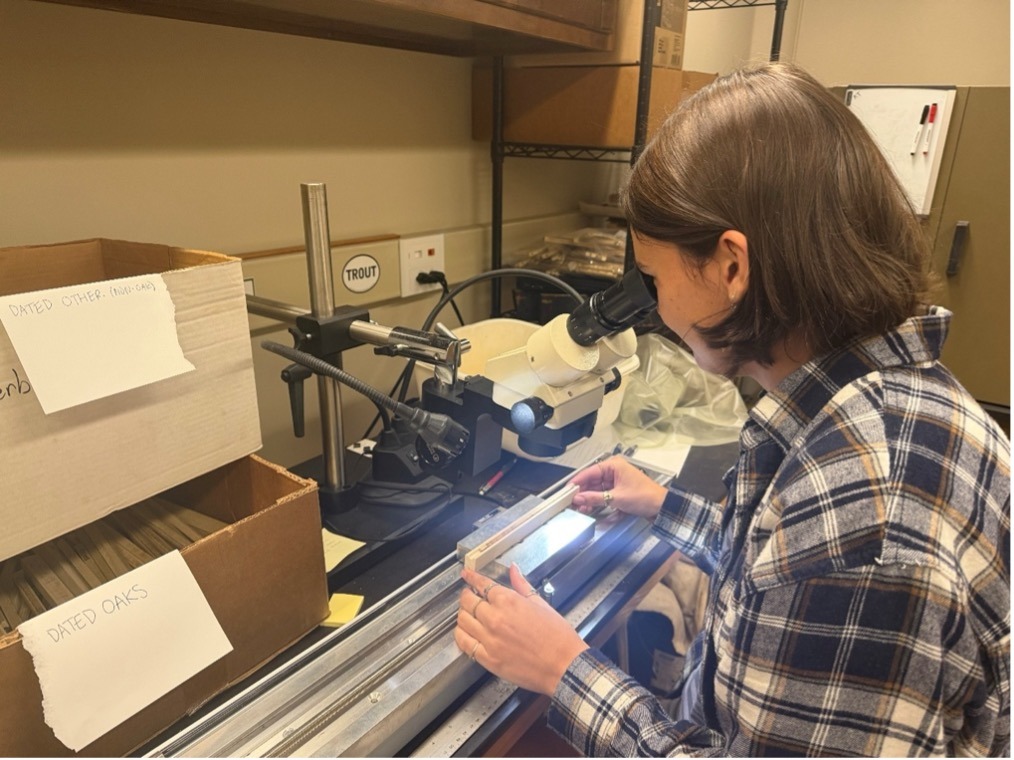
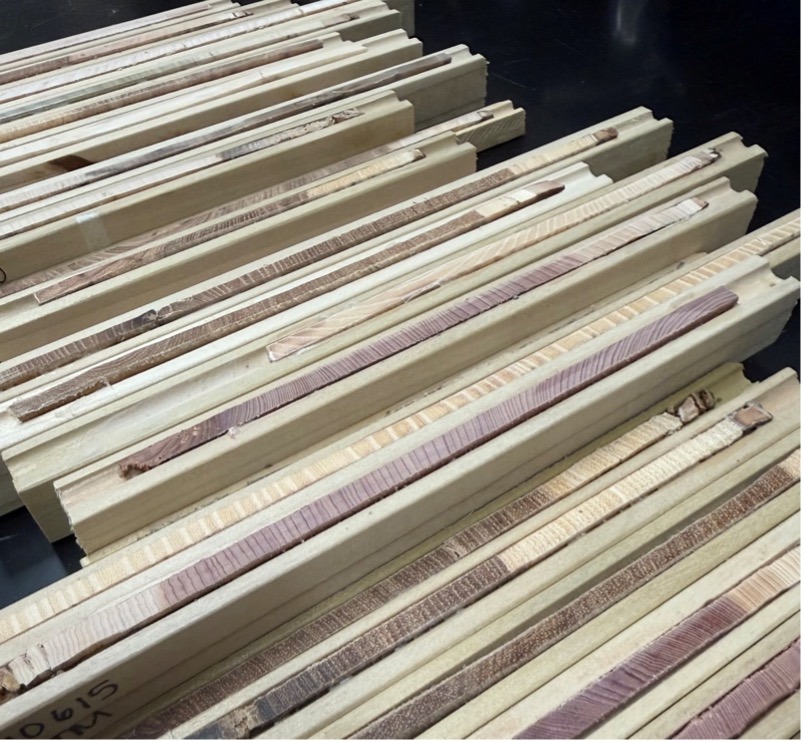
After a month of fieldwork at Paint Rock, we finally collected the last sample and returned to Tuscaloosa to begin processing. In the lab, we mount the tree cores with their cells vertically aligned and glued to a piece of routed wood, and then we sand the samples with abrasives at various levels to reveal the individual tree-ring structure. Once sanded, each tree-ring series is examined under magnification.
Kana and other students in the Forest Dynamics Lab date the annual rings to the calendar year of formation, identify scars or growth releases associated with disturbances using statistical techniques, and compile the information into geo-referenced datasets that can be analyzed alongside Paint Rock’s existing forest census records.
This is a long process, and one that is still ongoing. Though there is still much work to be done, I feel proud that through our research, we will be able to better understand the disturbance and developmental history of a Southeastern hardwood forest, which ultimately may improve the ability to manage it. Additionally, I am excited to see what further research will reveal about the extraordinary ecosystem at Paint Rock.