By Bill Finch, Founding Director
The gunshots of Independence were barely heard in Alabama, 250 years ago. Few people were left to hear them. The ones who remained couldn’t have cared much about the politics of a few cities on the Atlantic Coast.
For a time in the 18th century, Alabama was a place of no nations. The nations that had shaped it for thousands of years—the Alabama and Koasati, the Choctaws and Chickasaws, the Naniaba, the Apalachee, the Yuchi, and many others — had been mutilated by disease, enslavement, and wars. New nations—the French, the Brits, the Spaniards, and the people who hadn’t yet called themselves Americans—hoped to divvy up the spoils but still encroached timidly on the heart of the state, clinging to the coast and major rivers.
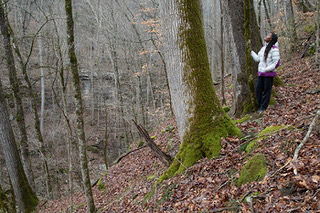
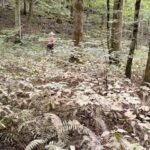
The slopes in Paint Rock are less uniformly covered in trees, supporting fragments of sun-loving summer-blooming flowers.
Photo by Beth Finch
Alabama became wild again in ways that it had not been wild since humans built the first communities here, more than 10,000 years ago. The great pre-Columbian mound cities, densely populated and surrounded by what were essentially sprawling suburbs, were almost forgotten at the time of the nation’s founding. Bartram describes small relict communities of Muskogean speakers, struggling to maintain their chiefdoms, and a single, miserable European outpost on the shores of Mobile Bay.
Nature was filing in the gaps. Canebrakes rapidly spread and reclaimed the river bottoms the First Nations had cleared for corn. Bison, by most accounts absent for many thousands of years, suddenly rebounded and flooded into the Black Belt prairies, the Huntsville basin grasslands, and even the pine savannas of South Alabama, free from the hunting pressure that had driven them west. Fires found their own way again through the landscape, no longer led by human burning practices, but following the lightning strikes that spread low flames from river to river, two or three times every decade in much of central and south Alabama, and almost as frequently in the north Alabama mountains and plateaus.
Much of what we know about the land of this state before it became a state comes from a travelogue written by William Bartram, a Pennsylvania native whose family had long made a living promoting the wonders of the New World to Europeans. There were suspicions Bartram may have been hired to spy for the aspiring Atlantic Coast nation. But as he traveled through the no-nation lands of Alabama, it seems unlikely that the man the Seminoles called “the flower hunter” provided much useful information to the rebellion.
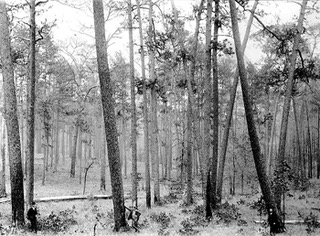
The most dominant forest type Bartram encountered in Alabama was savanna-like, with tall longleaf, shortleaf, or slash pines over sunlit meadows rich with grasses and wildflowers.
He was the last explorer who could see the remnants of the old nations even as the new nations were hot on his heels. He notes that bison, common a few decades before, seemed to have largely disappeared as the new settlers moved in. He describes the overgrown remnants of the old Choctaw peach plantations and abandoned villages along the Alabama River bluffs, even as he served as a sort of real estate agent for the new nations, declaring the wild bluffs at Wetumpka in central Alabama “one of the most eligible situations for a city in the world.”
To the European romantic poets who read Bartram, Alabama seemed like some kind of tropical paradise or nightmare. Bartram’s descriptions of Florida and Alabama in 1776-77 helped inspire Coleridge’s fevered vision of Xanadu, even as it sent savage chills down the spine of Wordsworth. The land would have been as strange to us. Magnolias indeed spread “high as a cloud” overhead, as Wordsworth paraphrased one of Bartram’s descriptions of Alabama. But England’s great poet of landscapes was a careful student of Bartram’s trips through the region, and he also celebrated the other vista of 18th century Alabama, “flowers that with one scarlet gleam” covered hundreds of miles.

Vistas like this one in a southeastern longleaf forest are what we hope to restore in northeast Alabama, with our native shortleaf pines presiding. | Photo by Beth Finch
The interplay between grand forests and sweeping sunlit meadows rich with flowers is almost impossible for the modern Alabamian to imagine. Most of Alabama’s forests weren’t really forests at all but more like savannas, with widely spaced pines and grounds drenched in sunlight. Sunlit pitcher plant bogs and flowering flatwoods, a rainbow of flowers and carnivorous plants at all seasons, are now rare and precious. But in Bartram’s day they stretched nearly unbroken along the Gulf: You could walk from the outskirts of New Orleans to Tallahassee, and rarely leave one, as Alabama biologist George Folkerts once noted.
Bartram missed the Paint Rock Valley and its surroundings, as did most explorers. DeSoto and his band of troublemakers skirted the edge of the valley in the 1500s, but the centuries after are a gray hole. Villages long dominated by the Yuchi and the Koasati in northeast Alabama and southeast Tennessee were abandoned as the Europeans encroached in the 1700s. Nature may have rebounded here briefly, much as it did in the rest of Alabama. We’re hoping the research at Paint Rock—including the work by University of Alabama’s forest dynamics lab—may help us reconstruct more precisely what the landscape looked like as the new nation gestated. And we’re working with the Koasati to discover clues to the landscape that may still be evident in their language.

Scenes like this one in Splinter Hill Bog in south Alabama are a tiny remnant of the spectacular pitcher plant bogs once common in both ends of the state. | Photo by Beth Finch
Paint Rock appears to have escaped the worst of 19th and 20th century deforestation and plowing. But the modern forest is a dim reflection of what it was in the 18th century. Mountain sides then as now likely supported the most diverse assembly of deciduous trees and shrubs in the United States, in some places so tall and dense they blocked the sun for much of the year. But the slopes may have been less uniformly covered in trees. Fragments of sun-loving, summer blooming sunflowers, tall green gentians, lilies, moon-flowered silphiums and warm season grasses still dot the slopes, the remnants of what must have been extensive nearly treeless glades. Plants that are now rare in that forest, like smoketrees and the federally threatened Morefield’s clematis vine, are struggling to find the light they once knew.
The flat-top plateaus that crown the tops of the slopes would be unrecognizable. Rather than being covered by the disease-ridden, slow-growing forest of weedy hardwoods we see there today, they were dominated by broad, grassy savannas with scattered shortleaf pine and chestnut. Pitcher plant bogs would have been almost as abundant as they were on the coastal plain. Mountain pitcher plants and their orchid, aster and lily companions occupied large stretches of Sand Mountain and the open shortleaf pine savannas stretching into Georgia and Tennessee At best only a few acres remain. Early accounts and modern research indicate that the river bottoms were a revolving mix of tall bottomland forests, chest-high grasslands that followed beavers and flooding, and extensive thickets of native cane standing 20 feet tall or more.
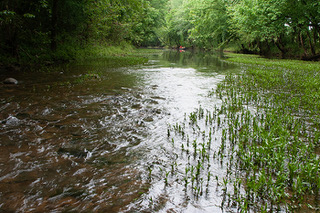
The constant motion and commotion of Paint Rock River’s waters offer one of the last opportunities for understanding how rivers used to work in the Tennessee Valley. | Photo by Beth Finch
What passes for a modern Alabama river is now dull, flat, damned to silence. Paint Rock is one of our last models of what a river might have looked like in the 18th century, and it’s a joy to hear it working loudly, day after day, night after night, tumbling over stones, logs and bars, creating thousands of deep pools and shallow riffles, one after another, for almost 60 miles. But all the original Alabama rivers roared. Some of the world’s most spectacular gorges, waterfalls and cascades passed through the heart of Alabama. The First Nations found much of their livelihood in that roar, yanking migrating redhorse; Alabama-run striped bass and shad; eel; and even giant sturgeon from the shoals. Paint Rock retains a portion of that freshwater richness, but in much of Alabama, the fish have been buried with the shoals, and some of the most important fish in Bartram’s day may never be seen again.
Somehow, on this 250th anniversary of the United States, Paint Rock again seems like a land suspended between two nations – the nation that trampled so much of its rich natural heritage without ever pausing to understand it, and the nation that for the first time seems ready to recognize it and learn from it. At Paint Rock, we aim to help build that new nation.