The first genomically informed forest is growing
By Kelsey Barnett-Fischels
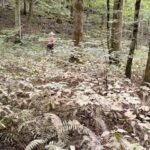
I don’t know what an ash tree looks like, I admit, sheepishly, to Mary Medlin, my coworker and one of Paint Rock Research Center’s science staff. She smiles kindly and walks me over to a scrawny tree in the 60-hectare forest dynamics plot tucked within The Nature Conservancy’s Sharp-Bingham Mountain Preserve.
“This is an ash.” She presses her thumbnail into the segments of bark and tells me to do the same. The wood squishes beneath my touch, firm but spongy. The trunk is thin enough that I can nearly wrap my fingers around its entirety. This is a young one. Once light shines through, Fraxinus takes its place among the crowning giants.
My familiarity with identifying ash comes just in time. In the bottomlands of the Paint Rock Valley, much like throughout the rest of the country, ash trees are dying. I begin to identify Fraxinus on my summer outings by the lack of leaves. I don’t dare to poke at the dead wood if I’m standing close enough. “Tree bones,” a forest director in Tennessee calls them. Their killer? The eastern ash borer, EAB, a metallic bullet-shaped beetle whose worm-like larvae tunnel through the wood and starve trees dead.
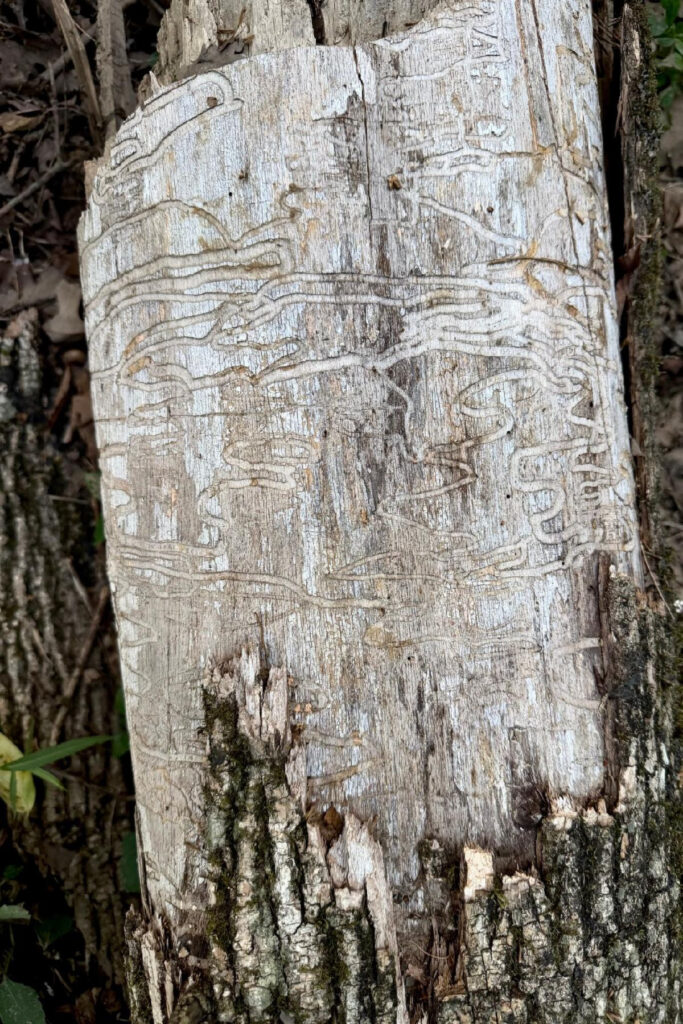
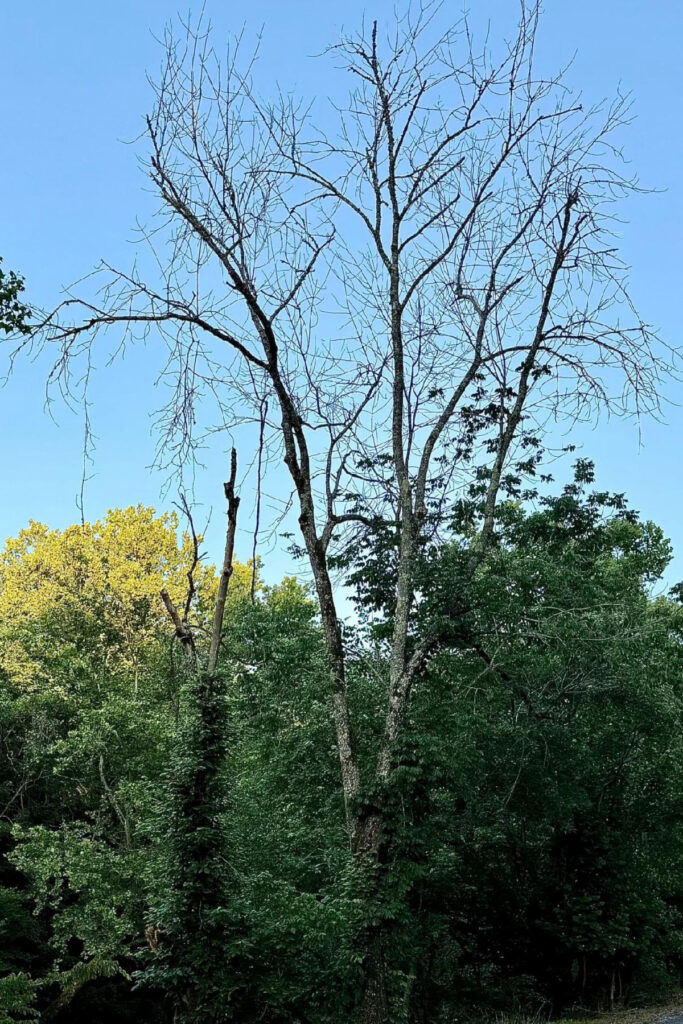
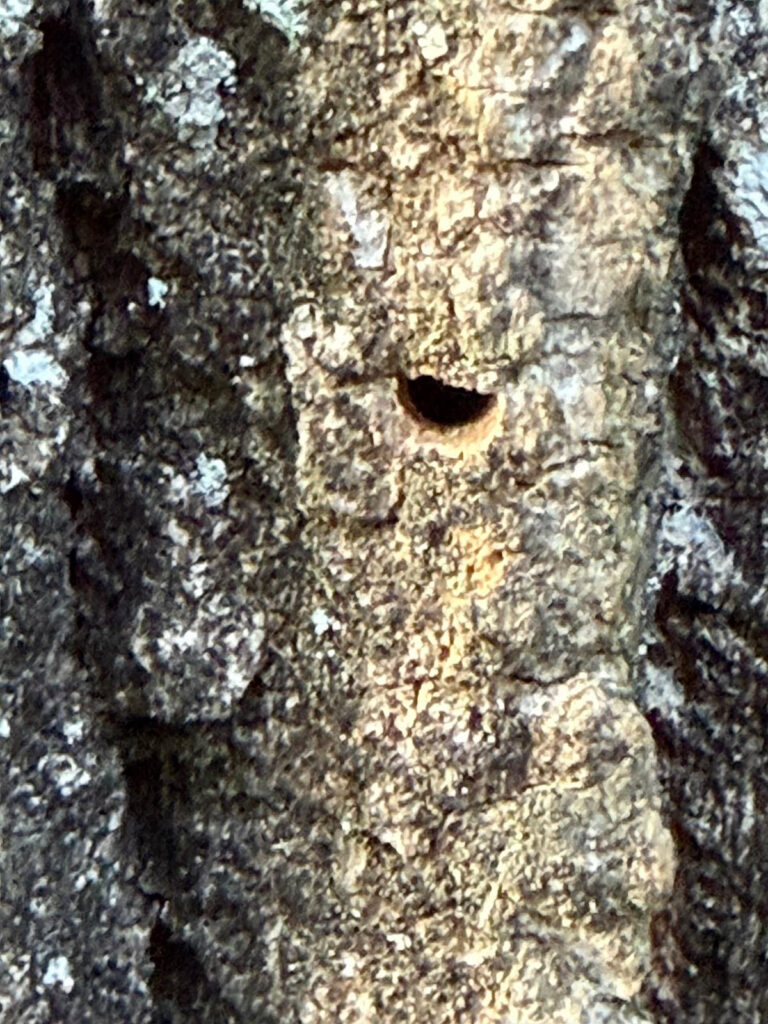
Emerald ash borer larvae create winding trails beneath the bark of ash trees and often leave “tree bones” of dead ash in their wake.
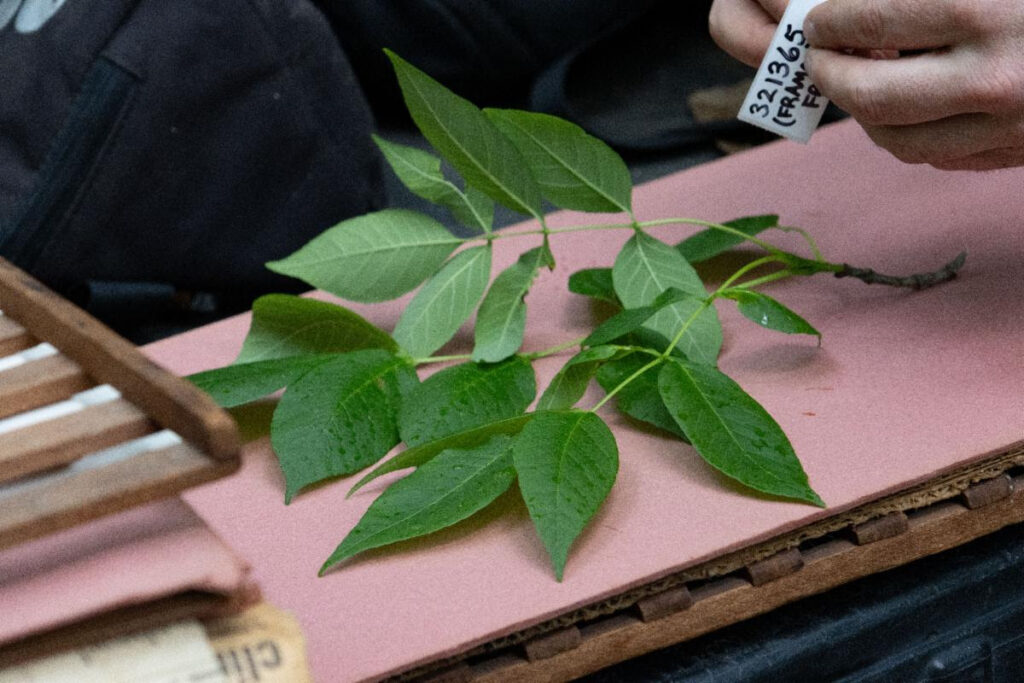
While I’m coming to terms with the ash genus by its morphology—the physical characteristics I can see and touch—a team from HudsonAlpha Institute for Biotechnology is vying for an even closer look. With hundreds of fresh leaf samples (632 to be exact), HudsonAlpha genetics experts are building full genome sequences of a large percentage of the Fraxinus within the Paint Rock forest dynamics plot.
It’s hard to say on the brink of so much Fraxinus death whether this genetic coding will become a conservation tool of hope or simply a record of lost potential. But at Paint Rock, we’re committed to learning as much as we can from this living laboratory, in ways that can inform how we care for North America’s forests for generations to come. And we have strong bets placed on gaining insights for the future.
“There are all these things hiding in this concept of species, and the only way to get at that is to begin thinking about individuals.”
— Bill Finch
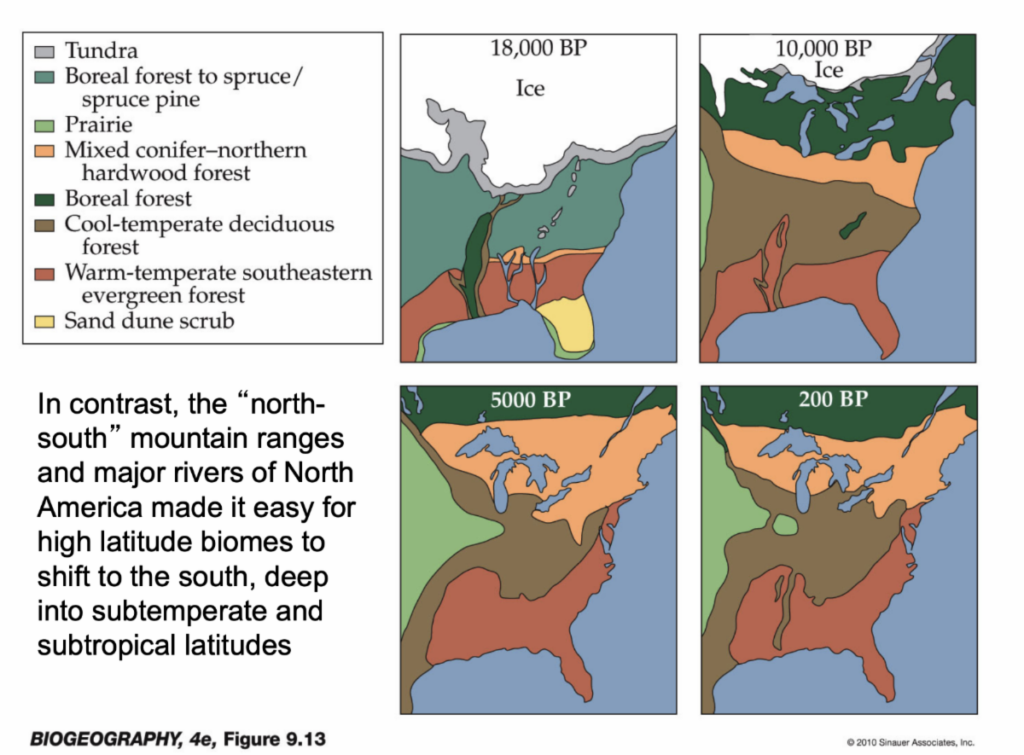
Source: Biogeography, 4e, Figure 9.13
While the outlook for ash trees across the country remains dire, Paint Rock forest experts expect some of our Fraxinus to survive the EAB infestations—a strong hunch grounded in our past. During the last ice age, all life north of Washington, D.C., and Cincinnati was smothered by glaciers. Diversity compressed itself into refugia across Alabama, Georgia, northwest Florida, and Mississippi. In the millions of years since at least the Miocene period, forests in Paint Rock have been growing and evolving. While surviving and evolving alongside complex pathogens and climate swings, genera like Fraxinus have developed a rich diversity in its number of species and genetic variation within individuals of a species. “There are all these things hiding in this concept of species, and the only way to get at that is to begin thinking about individuals,” says Bill Finch, Paint Rock’s founding director.
With the advantage of time, there have come to be five species of ash on the forest dynamics plot and six species of ash in the Paint Rock Valley. The traditional “white ash” of Paint Rock isn’t even genetically uniform. There are three species in the white ash group in the Paint Rock forest: Fraxinus americana, Fraxinus biltmoreana, and Fraxinus smallii. The ploidy levels, the number of complete sets of chromosomes in an individual, also differ from diploids (2 sets of chromosomes), to tetraploids (4 sets of chromosomes), to hexaploids (6 sets of chromosomes).
Finch emphasizes the importance of ploidy levels, a concept I’m still wrapping my head around. That individuals that seem to be within the same species can be genetically distinct, with different ploidy levels. That these ploidy lineages can fill new ecological niches as they evolve in response to pests and climate.
“We have the emerald ash borer coming down South. What does this mean?” Finch asks. “There’s some evidence that biltmoreana may be more resistant to the emerald ash borer than the straight diploid americana. We don’t know yet. But we’ll have fairly real-time evidence because we’ve catalogued every biltmoreana in the forest.”
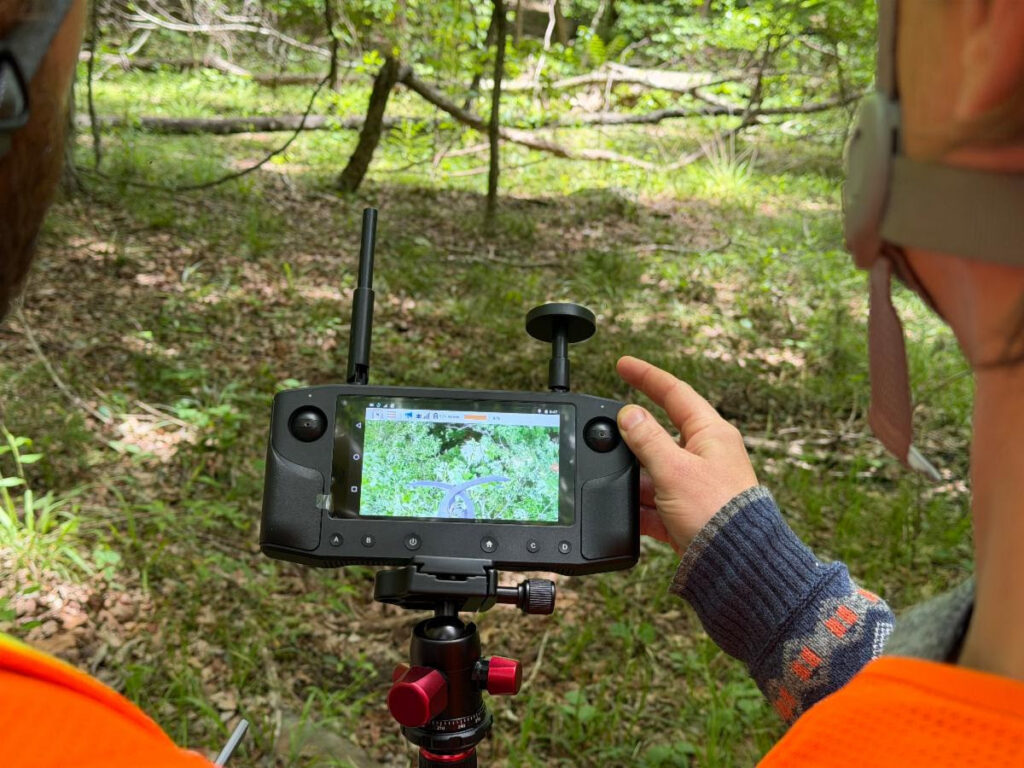
Our team has their feet on the ground to answer these questions. Landon Rakestraw stands in the forest wearing a hard hat and holding a device between his fingers. He’s not playing a handheld video game. As a key member of our science team, Rakestraw is undertaking collections from the tops of our Fraxinus trees.
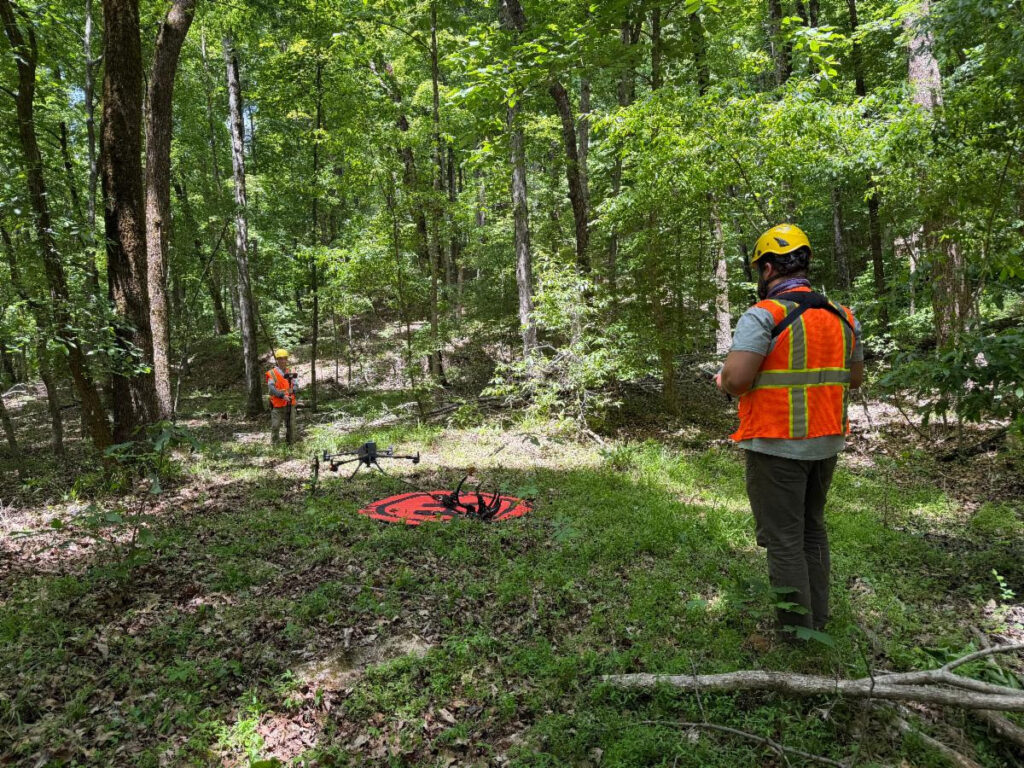
A buzzing fills the air, too consistent to be bird or bug. Necks crane to look skyward as a black beast rises from a safety orange landing pad. Rakestraw’s eyes stay glued to the video as he maneuvers the device safely through the understory and above the crowns of the forest.
Rakestraw has powered up a backpack-sized drone that carries with it mechanical arms and a built-in saw to collect young leaf samples from the tops of trees with as minimal disturbance as possible. Before the drone was pulled out, with easier-to-reach collections, he, our science lead Nathan Paris, and the rest of the crew used 30-foot-long Hastings poles and a slingshot that carried lines over limbs.
All of this is done with haste in the spring, when our ash trees are sprouting fresh growth. The Paint Rock science team collects and immediately freezes leaf samples in liquid nitrogen and places the collection tubes on dry ice, keeping them frozen until they’re delivered to the HudsonAlpha team.
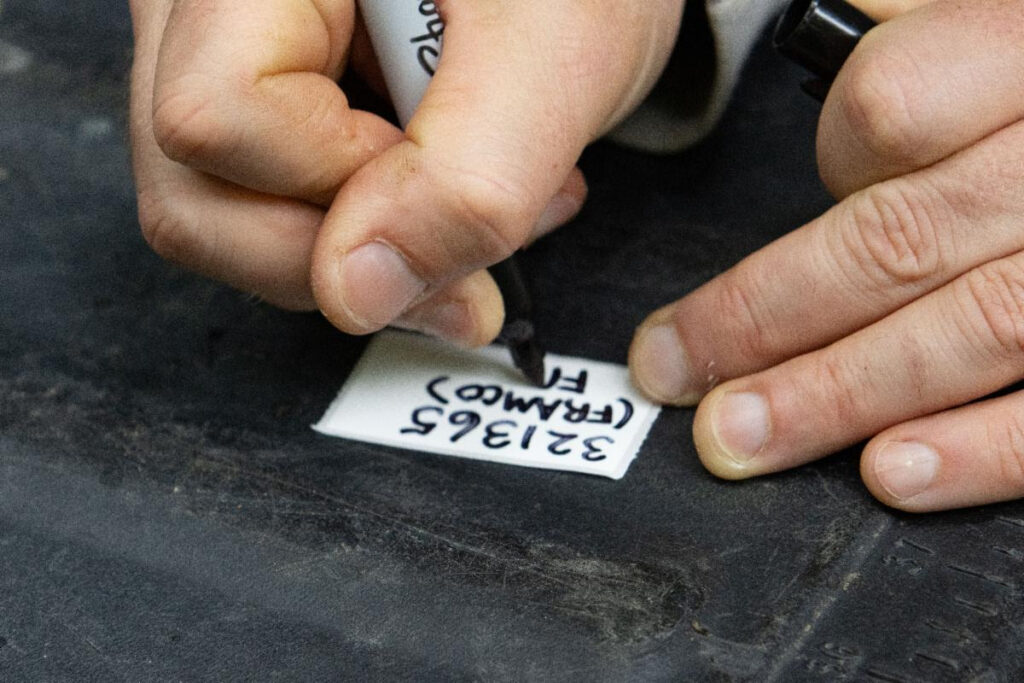
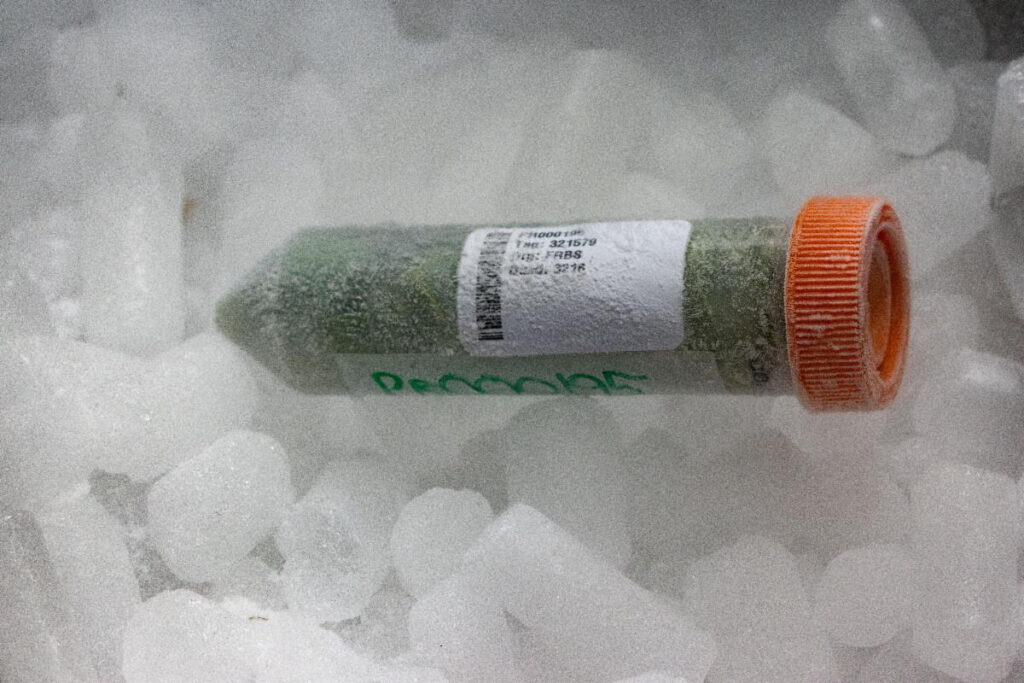
Then the HudsonAlpha team takes these samples and, in a way, creates libraries of life. They do so by first grinding the leaves into a fine, frozen powder. Then, they separate DNA from all the other cellular material and proteins. Lastly, they build a sequencing library, with a complete reference genome of the ash species.
Each new leaf sample gets a “Cliff notes” version of a sequence that’s compared to the reference genome. Any “errors” or “inconsistencies” between sample and reference genomes are called genetic variants. These characterize the genetic diversity and population structure of a species—which trees are related to which, which are parents and offspring, and which building blocks of life (alleles) are contributing to the long-term forest composition.
“We’re going to be able to apply all of this technology we’ve developed over many years to a real-world problem in the forest,” Jeremy Schmutz, HudsonAlpha faculty investigator, says. “How does a forest function? How does the forest stay healthy and reproduce? DNA sequencing allows us to make those measurements that we can then interpret and understand how their genetics interact with that specific environment.”
As a living ecological laboratory, Paint Rock researchers will watch in real-time as EAB moves through our forests. By tracking which ash trees die and which persist—all the while comparing their genomes with the help of HudsonAlpha—we can start to identify real patterns in the genetics of survival. With these insights, there is a real possibility we can identify lineages of ash trees that are most likely to fill in the gaps EAB leaves behind.