By Sakora Smeby, with Bill Finch
Bryce Lafferty, head of the art and design program at Jacksonville State University, and JSU photography professor Doug Clark are giving a face and voice to the Paint Rock forest and its inhabitants—from the vibrant moss growing on the edge of sandstone cliffs to small owls tucked in the crevices of hidden caves.


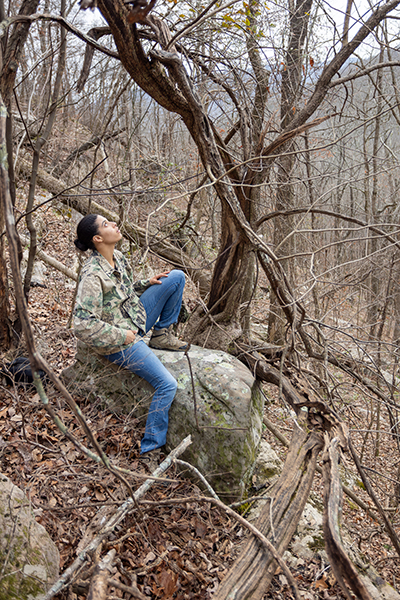
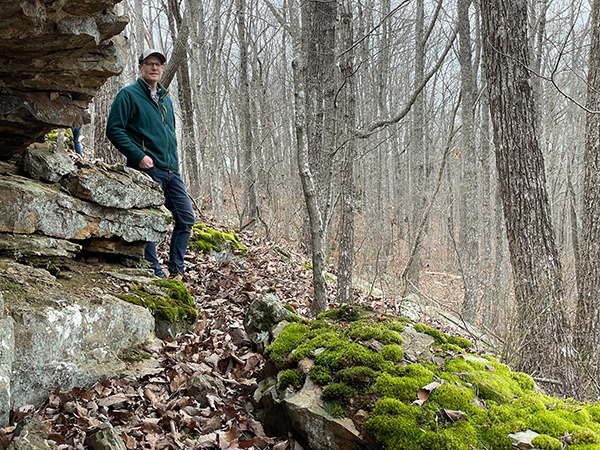
Lafferty is increasingly recognized for his unusual landscape representations, which slice into the heart of the land and the ecosystems he paints. Clark is a landscape photographer who’s working at many scales, capturing forests of mosses or trees. But their tour wasn’t just about what they see: They’re scouting the preserve for inspiring places that encourage developing student artists to express their own interpretations of how art and science collide.
Lafferty and Clark began their explorations in the soaring cave behind the research center’s main residential building. A steady stream of water rolls from the back of the cave and out the entrance, echoing off the rock walls, trickling past boulders that pile up on the slope of the mountain. This would be a great introduction for artists, both agreed.
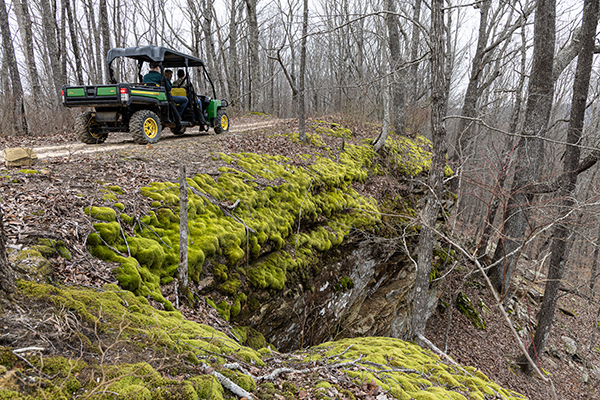
After a long buggy trip deep into the 4000-acre preserve, they settled into a large sink, the local name for a collapsed cave system. The artists couldn’t take their eyes off the ornate limestone walls, but they got a crash course in dendrology, learning about the various tree species discovered in the forest dynamics census taking place on the preserve.
We advanced further into the forest, climbing in elevation to a breathtaking view that overlooks the preserve. Growing on the cliffs are striking patches of moss, soft enough to lay on and too vividly green to ignore. They, of course, stole the attention of each person with a camera and Clark used the photo shoot as an opportunity to teach the group techniques for achieving quality images in nature.
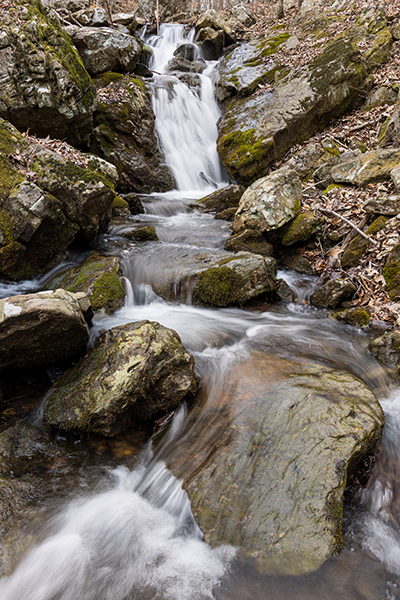
As we began losing daylight we trekked to a vast, stunning holler, cloaked by massive trees. Fallen timber was a bridge over the waterfalls rushing below. We photographed until everyone’s batteries bit the dust. Clark came prepared and had another camera handy. We capitalized on this and headed toward our last destination of the day.
As we bounced around in the buggy, descending down the mountain, we discussed the future and vision that they had for the fine arts program at JSU. We kicked around some ways that Paint Rock can help them present their ideas of intertwining science and art in expressions that can be enjoyed by the public.
We finally pulled off of the gravel road and weaved our way through trees and tall grass to get to the last spot: an old cave with a fascinating history. The deep cavern had served as a concert venue for bluegrass bands in its past, and additionally as a fallout shelter in case of a nuclear attack. Now the cavity is simply a home to those creatures who’d rather not be seen by the world. We ran into one of these shy souls when we came upon a small screech owl staring right at us. As a reminder of his talent for stealth, the petite predator practically disappeared before our eyes, exiting our view just as quickly as he had entered it.
Wrapping up, we could all agree that the day owed us nothing. By the time we parted ways our camera rolls were full, and intentions were laid out for what looks to be a bright future in the way of relations between Paint Rock and the fine arts program of Jacksonville State University.